17% off
5hSSC
Vocabulary for Competitive Exams
CAT, IPMAT, CUET, Banking, SSC & other competitive exams — master high-frequency vocabulary with exam-focused practice.
Starts from₹499Regular price ₹599
SSC GD 2025 paper from 13 February 2025, Shift 3, with circular seating, Haryanka history, polity, train problems and vocabulary, every question explained with a worked solution.
Choose Normal practice or a Simulated test.
Questions, answer key and solutions.
Across 4 sections
4 timed sections
Negative marking
Both use the same questions. Normal practice is untimed and needs no account: choose an option and the answer and solution appear at once. The Simulated test is the real computer-based format, with one 60-minute clock, a question palette and full screen, and your score, the key and the solutions arrive when you submit.
Every question on one page, loading as you scroll. Choose an option and see straight away whether it was right.
The computer-based test format: one clock, a question palette, and a score the moment you submit.
Circular seating, ancient Indian history, polity, mensuration and vocabulary are among the areas covered in this actual SSC GD 2025 question paper from 13 February 2025, Shift 3. The paper spans Reasoning, GK, Maths and English. Aptitude360 provides it as a solved PYQ, with an explained answer for each question.
SSC GD Constable candidates in the final revision stage who want to test themselves on an authentic recent shift.
How the paper is split, and how long each part runs. A section you have finished cannot be returned to.
| Section | Questions | Time |
|---|---|---|
| GD25 · 13 Feb 2025 · S3 · Reasoning | 20 | 15 min |
| GD25 · 13 Feb 2025 · S3 · GK | 19 | 15 min |
| GD25 · 13 Feb 2025 · S3 · Maths | 20 | 15 min |
| GD25 · 13 Feb 2025 · S3 · English | 20 | 15 min |
The analysis is ready the moment you submit the paper.
Marks, percentage, right, wrong and skipped, and the time you took.
The same figures for each section, so a weak one cannot hide in an average.
Every question with your answer, the right one, the working, and the video where there is one.
Your score against the spread of everyone else who has sat this test.
CAT, IPMAT, CUET, Banking, SSC & other competitive exams — master high-frequency vocabulary with exam-focused practice.
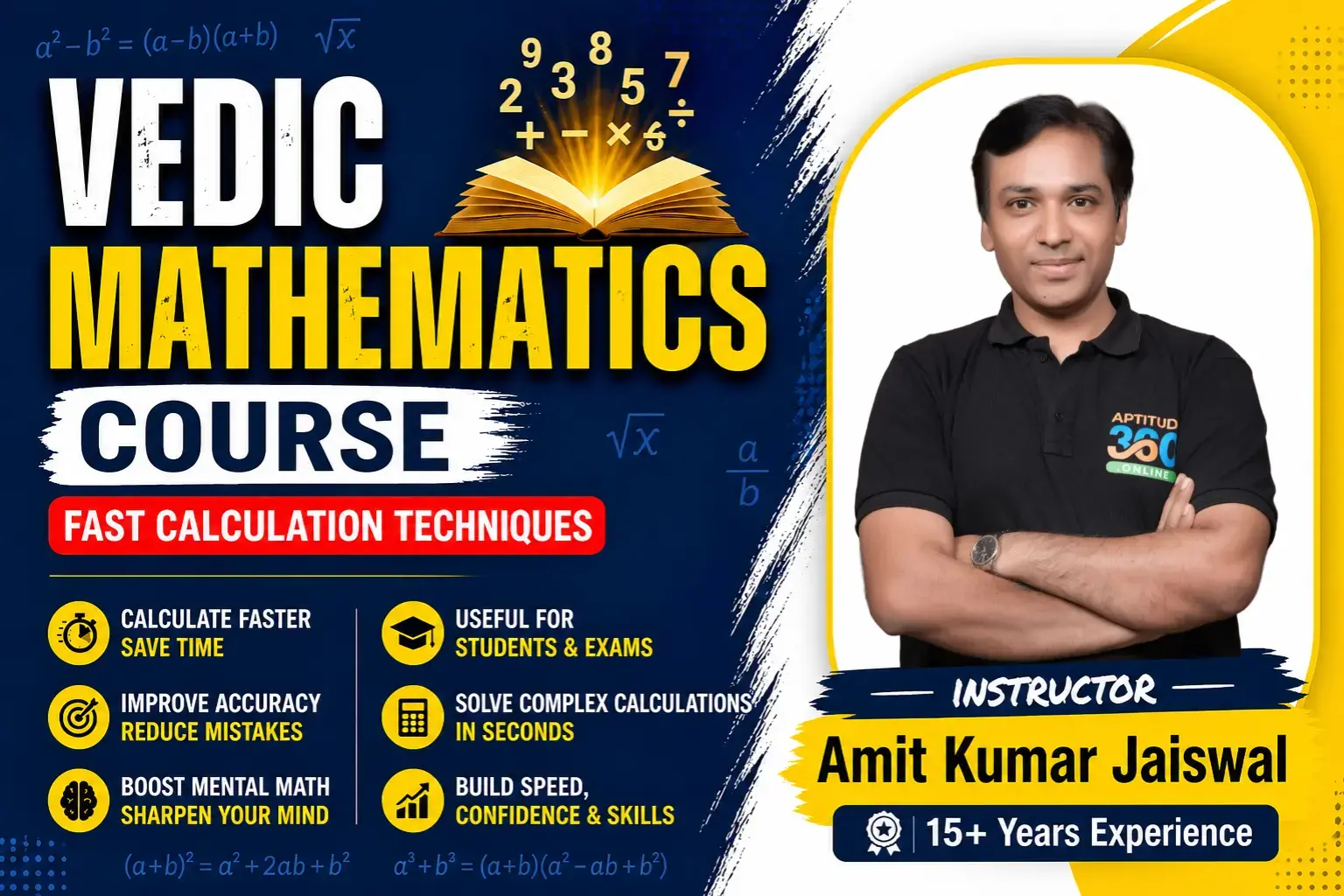
Learn powerful Vedic Math's tricks to solve calculations faster with speed and accuracy.
SSC Stenographer mock test series: 10 full-length mock tests in the latest SSC Stenographer pattern, each an online test with detailed solutions.