Exam Details
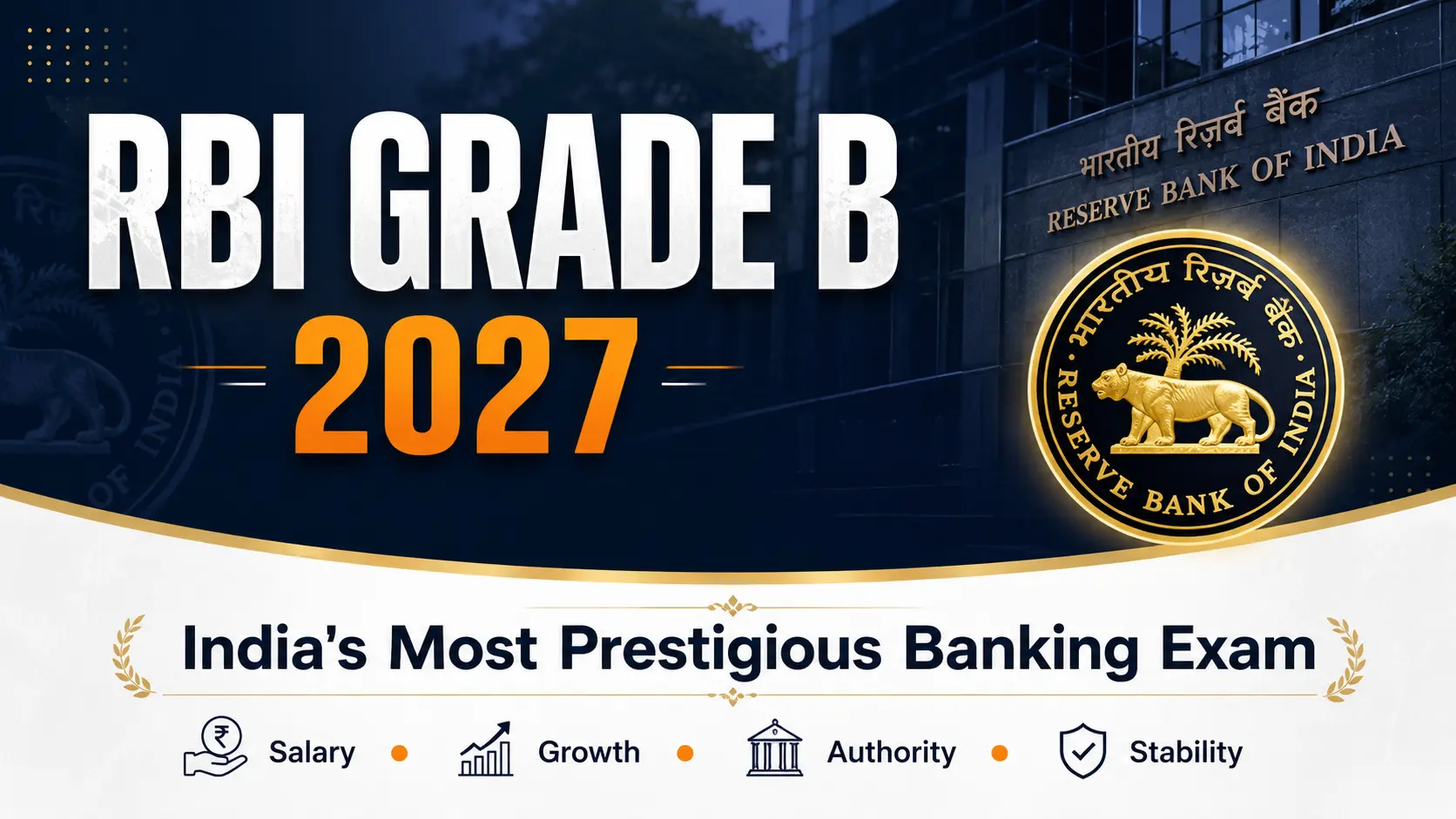
The Reserve Bank of India conducts the RBI Grade B Officer exam every year through the RBI Services Board, and this recruits officers into its General, DEPR (Department of Economic and Policy Research), and DSIM (Department of Statistics and Information Management) streams. Once you clear it, you join RBI as a Grade B Officer, and the work itself spans monetary policy, banking regulation, currency management, and economic research, so the role is broader than most banking exams prepare you for.
RBI Grade B is widely considered one of the toughest and most prestigious banking exams in India, and that reputation is earned. Lakhs of candidates apply every year for a very limited number of seats, so the exam does not just test aptitude, it tests whether you actually understand how the economy works and whether you can write about it clearly under time pressure.
At Aptitude 360, we break RBI Grade B preparation down into three parts. Building strong fundamentals across General Awareness and Quant and Reasoning for Phase 1, developing real command over Economic and Social Issues, Finance and Management, and descriptive writing for Phase 2, and practicing consistently with mock tests and previous year papers so none of this is unfamiliar on exam day.
Eligibility
RBI Grade B 2027 Eligibility Criteria: Age Limit, Qualification and Nationality
RBI Grade B 2027 Age Limit
| Category | Age Limit |
|---|---|
| General | 21 – 30 years |
| M.Phil holders | Upper limit extended to 32 years |
| Ph.D holders | Upper limit extended to 34 years |
RBI Grade B 2027 Age Relaxation (Category-wise)
| Category | Age Relaxation |
|---|---|
| OBC (Non-Creamy Layer) | 3 years |
| SC / ST | 5 years |
| Persons with Benchmark Disabilities (PwBD) | 10 years |
| Ex-Servicemen | As per government rules |
RBI Grade B 2027 Educational Qualification
| Stream | Qualification Required |
|---|---|
| General | Graduation in any discipline with minimum 60% marks (50% for SC/ST/PwBD), or Post-Graduation with minimum 55% marks |
| DEPR | Master's degree in Economics, Econometrics, Quantitative Economics, Mathematical Economics, or Finance (with Economics/Finance as principal constituent) |
| DSIM | Master's degree in Statistics, Mathematics, Economics, or related quantitative fields (including Data Science / AI / ML backgrounds where applicable) |
Nationality
You need to be an Indian citizen, or a subject of Nepal or Bhutan, or a Tibetan refugee who came to India before 1 January 1962 with the intention of permanent settlement, or a Person of Indian Origin who migrated from specified countries and holds an eligibility certificate issued by the Government of India where applicable.
Number of Attempts
- General / EWS: Maximum 6 attempts
- SC / ST / OBC / PwBD: No restriction on number of attempts, subject to the prescribed age limit
Exam Pattern
RBI Grade B 2027 Exam Pattern: Phase 1, Phase 2 and Interview
The RBI Grade B selection process for the General stream runs across three stages, Phase 1, Phase 2, and the Interview. Phase 1 is qualifying in nature only, so its marks are not counted anywhere in the final merit list. It is Phase 2 and the Interview that actually decide whether you get in.
RBI Grade B 2027 Phase 1 Exam Pattern
Phase 1 is an online, objective-type test with 200 questions for 200 marks, to be completed in 120 minutes, and the timing is fixed section-wise, so you cannot borrow time from one section to finish another.
| Section | No. of Questions | Marks | Time |
|---|---|---|---|
| General Awareness | 80 | 80 | 25 minutes |
| English Language | 30 | 30 | 25 minutes |
| Quantitative Aptitude | 30 | 30 | 25 minutes |
| Reasoning Ability | 60 | 60 | 45 minutes |
| Total | 200 | 200 | 120 minutes |
Marking Scheme: +1 for every correct answer, minus 0.25 for every incorrect answer, no penalty for questions left unattempted. You need to clear both the sectional cut-offs and the overall cut-off to move to Phase 2.
RBI Grade B 2027 Phase 2 Exam Pattern
Phase 2 has three papers, a mix of objective and descriptive questions, for a total of 300 marks. This is the stage that actually decides your final merit, so how you perform here matters far more than how you performed in Phase 1.
| Paper | Subject | Marks | Duration |
|---|---|---|---|
| Paper I | Economic & Social Issues (ESI) | 100 | 120 minutes |
| Paper II | English (Writing Skills, fully descriptive) | 100 | 90 minutes |
| Paper III | Finance & Management (FM) | 100 | 120 minutes |
| Total | 300 |
Paper I and Paper III each carry an objective section and a descriptive section. Paper II, the English paper, is entirely descriptive, essays, précis, and comprehension, and there is no negative marking on it. The objective portions of Paper I and Paper III do carry negative marking of minus 0.25 per wrong answer.
👉 For a detailed breakdown of how to prepare for the Phase 2 descriptive papers and score well in ESI and Finance & Management, [read our complete Phase 2 strategy guide]
RBI Grade B 2027 Interview
The Interview carries 75 marks and makes up roughly 20% of your final selection weightage. It usually covers your educational background, your work experience if you have any, current affairs, and questions on how RBI actually functions and how the economy is doing.
Note for DEPR and DSIM Streams
DEPR and DSIM follow a different Phase 1 and Phase 2 pattern, with subject-specific papers in Economics or Statistics respectively. So if you're applying under either of these streams, always cross-check the paper-wise pattern in the official RBI Grade B notification rather than assuming it mirrors the General stream.
Selection Process
RBI Grade B 2027 Selection Process: Step-by-Step
Phase 1: Qualifying Stage
Phase 1 exists only to shortlist you for Phase 2. Your Phase 1 score does not carry forward into the final merit, so there is no real advantage in scoring far beyond the cut-off. The actual competition starts at Phase 2.
Phase 2: The Stage That Decides Your Selection
Phase 2 marks, out of 300, go directly into your final merit calculation. You need to clear both the overall cut-off and the individual sectional cut-offs for ESI, English, and Finance and Management to get shortlisted for the Interview.
Interview: Final Stage
Once shortlisted, you appear for a personal interview worth 75 marks.
Final Merit Calculation
| Component | Marks Considered |
|---|---|
| Phase 1 | Not counted (qualifying only) |
| Phase 2 | 300 |
| Interview | 75 |
| Total for Final Merit | 375 |
The final merit list combines your Phase 2 and Interview marks. Category-wise and stream-wise cut-offs get released separately by RBI after each stage.
Practice Quizzes
 Free
Free
 Free
Free
 Free
Free
 Free
Free
 Free
Free
 Free
Free
Frequently Asked Questions
Exams You May Also Be Interested In
Explore similar exams that match your interests and help you prepare better for upcoming opportunities.
 Featured
 Featured