
RBI Grade B Salary 2027, Career Growth and How It Compares to SEBI Grade A and NABARD Grade A
A detailed comparison of RBI Grade B salary, perks, and career progression against SEBI Grade A and NABARD Grade A. Covers pay structure, promotion speed, posting patterns, and job nature across all three, plus a decision framework to help candidates choose based on career goals rather than starting pay alone.

Jatin SharmaAuthor
12 min read
- Last updated
- 12 Oct 2026
- Length
- 2,560 words

Introduction
Most candidates preparing for RBI Grade B eventually ask the same question in some form: is this actually the best option, or should I be preparing for SEBI Grade A or NABARD Grade A alongwith it? All three are regulatory or apex-institution officer exams, all three pay well, and syllabus overlap means many aspirants end up eligible for more than one. That overlap is exactly why the comparison matters, if you're going to invest a year of serious preparation, it helps to know what you're actually optimizing for before you pick.
This guide covers what RBI Grade B pays and how that grows over a career, then places it side by side with SEBI Grade A and NABARD Grade A on the things that actually differ, not just headline salary, but posting patterns, promotion speed, and the nature of the work itself.
Quick data note: Salary figures below are compiled from multiple sources current as of mid-2026 and reflect commonly cited ranges rather than a single official number, since take-home pay varies by posting city, accommodation status, and DA revisions. Cross-check exact current figures against each organisation's official notification or pay circular before treating any number here as final. One figure in particular, a claimed major NABARD wage revision bringing in-hand pay above ₹1,50,000, appears in only one source we found and conflicts with the majority of current listings, so we've flagged it separately rather than treated it as confirmed.
RBI Grade B Salary Structure
Component | Approximate Value |
|---|---|
Basic Pay | ₹78,450 per month (varies by source, ₹55,200–₹78,450 range reported) |
Gross Monthly Salary | ₹1,50,000 – ₹1,55,000 (varies by posting and accommodation) |
Approximate In-Hand | ₹1,10,000 – ₹1,30,000 per month |
Approximate Annual CTC | ₹30 – ₹34 lakh |
On top of this, officers receive Dearness Allowance, Grade Allowance, House Rent Allowance (or RBI-provided accommodation), Special Pay Allowance, and NPS contributions, along with subsidised loans for housing, vehicles, and education once confirmed after probation.
Perks and Benefits Beyond Salary
RBI Grade B's compensation isn't just the monthly figure, several perks meaningfully add to total value:
- Housing: RBI-provided accommodation at most postings, or a substantial HRA where accommodation isn't available
- Loans at concessional rates: housing, vehicle, and education loans well below market rates, available after confirmation
- Five-day work week: unlike many commercial banking roles, giving genuinely better work-life balance
- Leave and LTC: generous leave policy plus leave travel concession for officers and dependents
- Pension and NPS: structured retirement benefits alongside NPS contributions
- Holiday homes: subsidised accommodation at RBI-run holiday homes across popular destinations
- Smaller recurring perks that add up: a briefcase allowance (reimbursed once every three years) and an annual book grant are two of the lesser-known ones, small individually, but part of why RBI Grade B's effective compensation runs meaningfully above the headline salary figure
Career Growth Path
This is where RBI Grade B has a structural advantage worth understanding clearly, and it's not just about pay.
Direct entry as Manager, skipping two levels. Most officer-grade recruitment (including SEBI and NABARD Grade A) brings you in as an Assistant Manager. Clearing RBI Grade B brings you in directly as Manager (Grade B), which means you enter RBI's officer hierarchy two rungs ahead of where an equivalent-level exam elsewhere would place you.
Seeing
the three ladders side by side makes this clearer than describing it in words:
Entry Point | RBI Grade B | SEBI Grade A | NABARD Grade A |
|---|---|---|---|
Level 1 | (skipped by direct entry) | Grade A (Assistant Manager) | Grade A (Assistant Manager) |
Level 2 | (skipped by direct entry) | Grade B (Manager) | Grade B (Manager) |
Where you actually start | Grade B (Manager) | Grade A (Assistant Manager) | Grade A (Assistant Manager) |
Next promotion up | Grade C (Assistant GM) | Grade B (Manager) | Grade B (Manager) |
The promotion ladder from there:
Manager (Grade B) → Assistant General Manager (Grade C) → Deputy General Manager (Grade D) → General Manager (Grade E) → Chief General Manager (Grade F) → Principal Chief General Manager → Executive Director → Deputy Governor → Governor
Promotion to Grade C typically takes around 5-7 years, with subsequent promotions following at roughly 4-5 year intervals depending on performance, vacancies, and internal policy. Officers are also transferred across departments and locations every 3-5 years, gaining exposure to Financial Markets, Banking Regulation, Banking Supervision, Currency Management, Public Debt, Foreign Exchange, and HR functions along the way.
The Month-One Illusion
Here's a framing worth keeping in mind whenever you're comparing exams purely by their starting salary: the number you see on Day One tells you almost nothing about where you'll be by Year 15. A candidate anchoring purely on gross pay in the first year of RBI Grade B versus SEBI Grade A versus NABARD Grade A is comparing three careers at their least differentiated point. Entry-level compensation across all three is genuinely close. What actually diverges, and diverges a lot, is how fast each ladder moves and where it caps out, which is exactly why RBI's two-rung head start compounds into a meaningfully different trajectory by the time officers reach AGM and DGM level, even if the Month One paycheck looked similar to a competing offer.
What a Day in the Life of an RBI Grade B Officer Looks Like
Day-to-day work varies significantly by department and posting, but broadly, Grade B officers are involved in policy implementation, data analysis and reporting, supervision of banks or NBFCs (depending on department), drafting notes for senior management, and coordination across regional and central offices. Unlike many commercial banking roles, there's limited public-facing customer interaction, RBI Grade B is closer to a policy and regulatory desk job than a branch banking one, which is worth knowing if your image of "banking job" is shaped by SBI PO or IBPS PO style roles.
RBI Grade B vs SEBI Grade A: Salary, Role and
Growth Comparison
Factor | RBI Grade B | SEBI Grade A |
|---|---|---|
Entry Level | Manager (Grade B), direct entry | Assistant Manager (Grade A) |
Basic Pay | ~₹78,450 | ~₹62,500 |
Gross Monthly (approx.) | ~₹1,50,000 – ₹1,55,000 | ~₹1,43,000 – ₹1,84,000 (varies by accommodation) |
Approx. Annual CTC | ~₹30 – ₹34 lakh | ~₹20 – ₹24 lakh |
Typical Posting | Pan-India, including regional and zonal offices | Predominantly metro cities (Mumbai, Delhi, Bengaluru, Chennai, Ahmedabad, Kolkata); no rural postings |
Core Work Area | Monetary policy, currency management, banking regulation and supervision | Securities market regulation, investor protection, capital markets oversight |
First Major Promotion | Grade C (AGM), approx. 5-7 years | Grade B, approx. 3 years |
The practical difference: SEBI Grade A's first promotion comes faster, and its work is narrowly focused on capital markets, which suits candidates specifically drawn to securities and financial markets regulation. RBI Grade B's broader mandate and pan-India posting suit candidates who want exposure across monetary policy, banking supervision, and macroeconomic functions, along with a head start of two entry-level rungs that plays out over a longer career.
RBI Grade B vs NABARD Grade A: Salary, Role and
Growth Comparison
Factor | RBI Grade B | NABARD Grade A |
|---|---|---|
Entry Level | Manager (Grade B), direct entry | Assistant Manager (Grade A) |
Basic Pay | ~₹78,450 | ~₹44,500 |
Gross Monthly (approx.) | ~₹1,50,000 – ₹1,55,000 | ~₹1,00,000 (commonly cited; one source claims a revision to ₹1,50,000+, unconfirmed across other sources) |
Approx. Annual CTC | ~₹30 – ₹34 lakh | ~₹16 – ₹18 lakh (commonly cited) |
Typical Posting | Pan-India, regional and zonal offices | Regional offices (state capitals) and Head Office Mumbai; field/district postings possible after promotion |
Core Work Area | Monetary policy, currency management, banking regulation | Rural development, agricultural credit, financial inclusion, supervision of RRBs and cooperative banks |
First Major Promotion | Grade C (AGM), approx. 5-7 years | Grade B (Manager), approx. 2-3 years |
The practical difference: NABARD Grade A offers meaningfully faster first promotions and a genuinely distinct mission, rural development and agricultural finance, rather than macro-level monetary policy or capital markets. If that developmental mandate appeals to you specifically, NABARD is a legitimate first choice rather than a fallback. On pure compensation, RBI Grade B currently sits ahead based on the majority of available figures, though NABARD's wage revision cycle means this gap can shift, worth watching if you're weighing both.
Which One Should You Choose? A Decision Framework
Rather than ranking these three as better or worse, it helps to separate the decision into what you're actually optimizing for:
If compensation and pan-India macro exposure matter most to you: RBI Grade B's direct Manager-level entry and broader regulatory mandate make it the strongest overall pick among the three, provided you're comfortable with a longer wait for your first promotion.
If you want capital markets specifically, and faster initial promotion: SEBI Grade A is the more targeted choice, understanding that postings are metro-only, which matters if you have strong ties to a non-metro base like the Tricity and value staying closer to home in your early career.
If you're drawn to rural development and agricultural finance as a mission, not just a job: NABARD Grade A offers the fastest promotion cycle among the three and a genuinely different, developmentally-oriented career, worth choosing on its own merits rather than only as a fallback if RBI doesn't work out.
If you're eligible for more than one and genuinely unsure: Prepare for RBI Grade B as your primary target. The next section covers exactly how much of that prep transfers if you decide to add SEBI or NABARD as a backup.
Can You Prepare for NABARD or SEBI Alongside RBI Grade B?
Short answer: yes, but the two aren't equally efficient to add on. Think of NABARD and SEBI not as separate exams to prepare from scratch, but as extensions of your RBI Grade B base, with very different amounts of extra work depending on which one you pick.
How Much of Your RBI Prep Actually Transfers
Here's
the honest picture. NABARD Grade A's Phase 2 pairs an English descriptive paper
with a combined ESI and Agriculture & Rural Development (ARD) paper. The
ESI portion draws on largely the same ground RBI already tests, several prep
resources go as far as saying RBI and NABARD aspirants don't need separate ESI
material at all, since NABARD simply applies the same economic and social
themes through a rural lens. ARD is the one genuinely new subject, agricultural
practices, rural credit institutions, irrigation, and government rural
development schemes, none of which shows up in RBI's syllabus.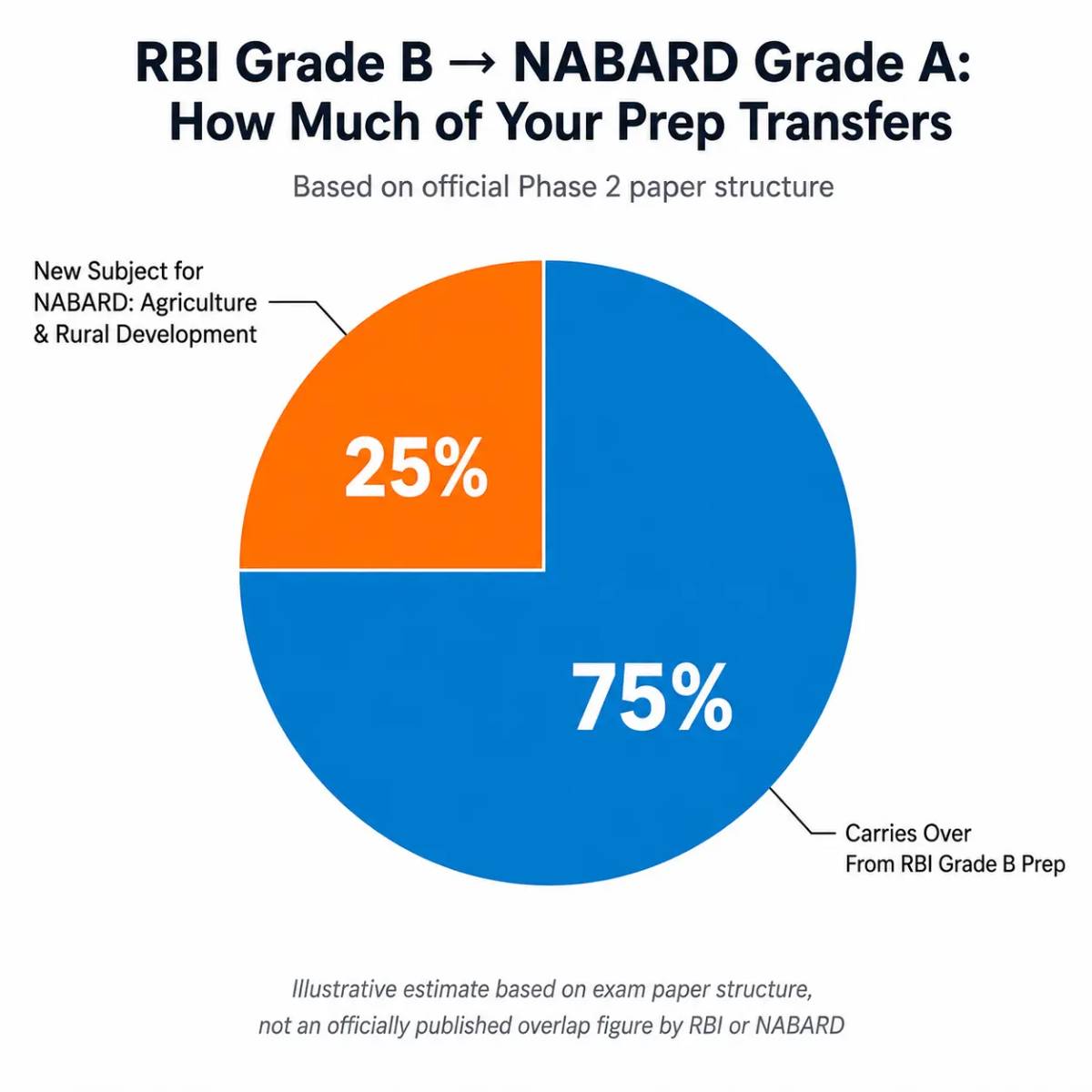
SEBI Grade A's Paper 2 looks different. It's built from six named subject areas: Commerce & Accountancy, Management, Finance, Costing, Companies Act, and Economics. Of these, Finance, Management, and (loosely) Economics overlap with what RBI's Finance & Management paper already covers. But Commerce & Accountancy, Costing, and the Companies Act are technical subjects RBI doesn't touch at all, and as of the current pattern, SEBI's Paper 2 for the General stream is purely objective, no descriptive component, unlike RBI and NABARD's mixed format. So it's not just new content, it's also a different exam skill (MCQ speed and accuracy on unfamiliar technical subjects, rather than descriptive depth).
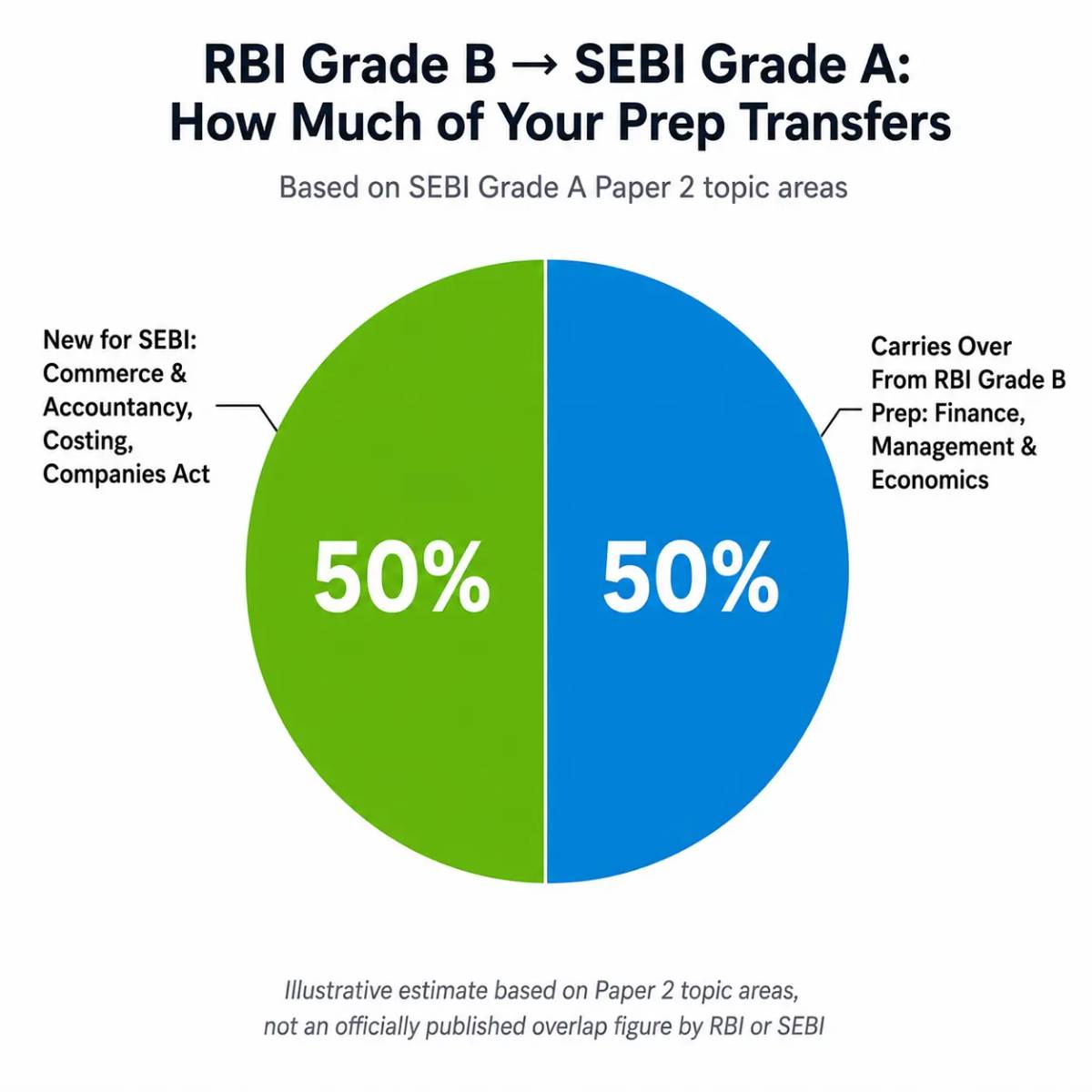
Both charts above are illustrative, based on how each exam's papers and named topic areas are structured, not an officially published overlap percentage from RBI, SEBI, or NABARD. Treat them as a rough guide to where your existing prep helps and where it doesn't, not an exact science.
When Do These Exams Actually Fall in the Year
Overlap only matters if you know which exam's Mains lands first in a given cycle, and this is where the three exams behave quite differently.
NABARD and SEBI follow a reasonably predictable rhythm. NABARD's notification typically comes out between July and November, with Phase 1 about 1-2 months later and Phase 2 (Mains) roughly a month after that, placing NABARD's Mains most often in the November-January window. SEBI follows a similar but slightly later rhythm, notification usually between September and November, Phase 1 in December or January, and Phase 2 (Mains) in February or March.
RBI Grade B does not follow a fixed calendar at all, and this is worth taking seriously rather than assuming a pattern. Over recent cycles, RBI's notification has landed anywhere from April to September, and its Phase 2 (Mains) has landed anywhere from July to December depending on the year. There's no reliable "RBI always comes before/after NABARD and SEBI" rule you can plan around blindly.
What this means practically: in some years, NABARD or SEBI's Mains exam can genuinely land before RBI Grade B's own Mains, even if RBI is your primary target and you started preparing for it first. This changes how a backup should actually be sequenced, you can't assume you'll always finish your full RBI Grade B prep before a backup exam's Mains arrives. The safe approach is to check each year's actual notification dates for all three as soon as they're out, rather than building a study plan around an assumed order.
If RBI Grade B Is Your Main Target, Which One Should Be Your Backup
Based on this, NABARD Grade A is the more efficient backup to prepare alongside RBI Grade B, since the additional workload is essentially one new subject (ARD) layered on top of prep you're already doing. SEBI Grade A is still a legitimate backup if capital markets genuinely interest you, but go in knowing it's a heavier lift, three new technical subjects built from scratch, in an objective-only format that doesn't reuse RBI's descriptive-writing practice the same way NABARD's paper does.
A simple way to sequence it, if you want a backup:
- Core RBI Grade B prep (ESI, English, FM) already covers most of NABARD's requirement, so there's no separate "NABARD phase" needed for English or ESI.
- Start ARD early, not late. NABARD's Mains often lands before RBI's own, so add a light ARD track (a few hours a week) once your ESI base is in place, rather than waiting for your full RBI syllabus to be done. Check each year's actual notification dates rather than assume RBI comes first.
- SEBI needs its own dedicated block closer to its exam date (typically February-March). Commerce & Accountancy, Costing, and Companies Act won't emerge naturally from RBI or NABARD prep, they need real time built from zero.
Tricity aspirant tip: If you're weighing all three and not sure which one to commit your main prep effort to, this is exactly the kind of decision worth mapping out with a mentor rather than alone. Drop by our Sector 34A classroom in Chandigarh to sit down with our banking faculty and evaluate your baseline strengths across ESI, FM, and English before deciding where to put your primary focus.
Final Verdict by Aptitude360
There's
no universally "better" choice among these three, only a better fit
for what you actually want out of the next 20 years. RBI Grade B's direct entry
as Manager and pan-India regulatory mandate make it the strongest all-round
pick for most candidates, but SEBI's faster promotion cycle and capital-markets
focus, or NABARD's rural development mission and quicker first promotion, are
both legitimate reasons to prioritise them instead, not just consolation
options. Decide based on the work you'd actually want to be doing at year ten,
not just the number on the offer letter.
Sources
- Reserve Bank of India, Official Notifications: [www.rbi.org.in]
- Securities and Exchange Board of India, Pay Scales: [www.sebi.gov.in]
- NABARD, Official Recruitment Portal: [www.nabard.org]
Online, offline or hybrid
See Where Your Preparation Stands
With a Free Demo or Assessment
Book a demo class or take our assessment test to check your current preparation level. Both are free, with no obligation.