Skip to content

XAT 2017 QADI Previous Year Questions with Detailed Solutions

Prepare for XAT 2017 Quantitative Aptitude & Data Interpretation (QADI) with previous year questions and detailed solutions. Practice arithmetic, algebra, geometry, number systems, and data interpretation to strengthen your quantitative skills for the XAT MBA entrance exam.

Start Test

Choose Normal practice or a Simulated test.

Questions, answer key and solutions.

Questions
27
Duration
60 min
Marks
27

Negative marking

Attempts
100
Access
Free

Normal practice, or a Simulated test

The same questions, either way. Normal practice teaches; the simulated test tells you where you stand.

No account needed

Normal

Untimed

Every question on one page, loading as you scroll. Choose an option and see straight away whether it was right.

  • No timer. Nothing to start and nothing to submit. Stop whenever you like.
  • Answered as you choose. Tap an option and it is marked at once, with the correct answer shown.
  • Solutions in place. The explanation, and the video where one has been added, sit under the question.
  • Open to guests. Normal practice needs no sign-in.
Open Normal practice
Real exam conditions

Simulated

Timed CBT

The computer-based test format: one clock, a question palette, and a score the moment you submit.

  • A clock that does not pause. 60 minutes from the moment you begin, and the paper is submitted for you when it reaches zero.
  • Question palette. Answered, not answered and marked for review, section by section, as the real interface has it.
  • Full screen, proctored. The test takes over the screen; leaving it three times submits the paper.
  • Answers hidden until you submit. The key, the explanations and your score all arrive together at the end.

About this test

XAT 2017 QADI Previous Year Questions with Detailed Solutions

Prepare for the Xavier Aptitude Test (XAT) with XAT 2017 Quantitative Aptitude & Data Interpretation (QADI) Previous Year Questions with Detailed Solutions on Aptitude360. This practice test helps MBA aspirants understand quantitative problem-solving methods, interpret data, and become familiar with the question patterns of the XAT examination.

Topics Covered in XAT 2017 QADI

This XAT 2017 QADI practice set covers arithmetic, algebra, number systems, geometry, mensuration, percentages, ratios and proportions, time and work, time-speed-distance, probability, and data interpretation. Practice mathematical problems, tables, charts, and numerical exercises to strengthen conceptual understanding and analytical skills.

XAT 2017 QADI Previous Year Questions with Solutions

Attempt XAT 2017 Quantitative Aptitude & Data Interpretation previous year questions to assess your preparation and improve calculation accuracy. Detailed solutions explain the methods used to solve quantitative problems and interpret data, helping you understand challenging questions and develop an effective problem-solving approach.

Why Practice XAT QADI Previous Year Questions?

Solving XAT previous year questions with detailed solutions helps you identify important topics, improve numerical accuracy, and become familiar with exam-level quantitative problems. Use the Aptitude360 Previous Year Question Series to evaluate your preparation and build confidence for the XAT MBA entrance examination.

Test structure

How the paper is split, and how long each part runs. A section you have finished cannot be returned to.

SectionQuestionsTime
XAT 2017 QADI2760 min

Questions with solutions

All 27 questions of this test. Open "Answer and solution" under a question to check it.

  1. Question 1

    The sum of series, \((-100) + (-95) + (-90) + \ldots + 110 + 115 + 120\), is:

    1. A. 0
    2. B. 220
    3. C. 340
    4. D. 450
    5. E. None of the above
    Answer and solution

    Answer: D

    Solution: The given series is \((-100) + (-95) + (-90) + \ldots + 110 + 115 + 120\).
    We can observe that -100 will cancel out 100, -95 will cancel out 95 and so on. Therefore, the only terms that will be remaining are 105, 110, 115 and 120.
    Sum of the series = 105 + 110 + 115 + 120 = 450.
    Therefore, option D is the right answer.

  2. Question 2

    Four two-way pipes A, B, C and D can either fill an empty tank or drain the full tank in 4, 10, 12 and 20 minutes respectively. All four pipes were opened simultaneously when the tank is empty. Under which of the following conditions the tank would be half filled after 30 minutes?

    1. A. Pipe A filled and pipes B, C and D drained
    2. B. Pipe A drained and pipes B, C and D filled
    3. C. Pipes A and D drained and pipes B and C filled
    4. D. Pipes A and D filled and pipes B and C drained
    5. E. None of the above
    Answer and solution

    Answer: A

    Solution: Let us assume the volume of the tank to be 60 litres.
    A can fill or empty 60/4 = 15 litres in a minute.
    B can fill or empty 60/10 = 6 litres in a minute.
    C can fill or empty 60/12 = 5 litres in a minute.
    D can fill or empty 60/20 = 3 litres in a minute.

    We have to find the combination for which the tank will be half-full in 30 minutes (i.e., completely filled in 1 hour).
    Therefore, the combination must result in a net input of 60/60 = 1 litre per minute.

    Let us evaluate the options.
    Option B:
    Pipe A drained and pipes B, C and D filled

    The net result will be -15 + 6 + 5 + 3 = -1 litre/minute. We can eliminate option B.

    Option C:
    Pipes A and D drained and pipes B and C filled

    The net result will be -15-3+6+5 = -7 litres/minute. We can eliminate option C as well.

    Option D:
    Pipes A and D filled and pipes B and C drained
    The net result will be 15+3-6-5 = 7 litres/minute. We can eliminate option D as well.

    Option A:
    Pipe A filled and pipes B, C and D drained

    The net result will be 15-6-5-3 = 1 litre/minute.
    Therefore, option A is the right answer.

  3. Question 3

    A shop, which sold same marked price shirts, announced an offer - if one buys three shirts then the fourth shirt is sold at a discounted price of ₹ 100 only. Patel took the offer. He left the shop with 20 shirts after paying ₹ 20,000. What is the marked price of a shirt?

    1. A. ₹ 1260
    2. B. ₹ 1300
    3. C. ₹ 1350
    4. D. ₹ 1400
    5. E. ₹ 1500
    Answer and solution

    Answer: B

    Solution: Patel bought 20 shirts. He would have gotten every fourth shirt at Rs. 100. He would have paid the marked price for 15 shirts and would have gotten 5 shirts at Rs. 100 each.

    Let the marked price of one shirt be 'x'.
    15x + 5*100 = 20000
    15x = 19500
    x = 19500/15 = Rs. 1300.
    The marked price of a shirt is Rs. 1300. Therefore, option B is the right answer.

  4. Question 4

    AB is a chord of a circle. The length of AB is 24 cm. P is the midpoint of AB. Perpendiculars from P on either side of the chord meets the circle at M and N respectively. If PM < PN and PM = 8 cm. then what will be the length of PN?

    1. A. 17 cm
    2. B. 18 cm
    3. C. 19 cm
    4. D. 20 cm
    5. E. 21 cm
    Answer and solution

    Answer: B

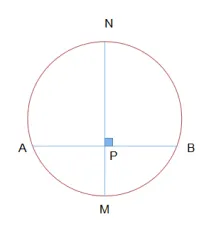
    Solution: Let us draw the diagram using the given conditions.

    AB = 24 cm and P is the mid-point of AB. Therefore, AP=PB=12 cm.
    MN is perpendicular to AB and passes through P.
    PM < PN. Therefore, M should be closer to A and B than N.
    MN and AB are 2 perpendicular chords intersecting at P.
    Therefore, according to the intersecting chords theorem, AP*PB = PM*PN
    12*12=8*PN
    => PN = 18 cm.
    Therefore, option B is the right answer.

  5. Question 5

    If \(x\) and \(y\) are real numbers, the least possible value of the expression \(4(x - 2)^2 + 4(y - 3)^2 - 2(x - 3)^2\) is :

    1. A. - 8
    2. B. - 4
    3. C. - 2
    4. D. 0
    5. E. 2
    Answer and solution

    Answer: B

    Solution: \(4(x - 2)^2 + 4(y - 3)^2 - 2(x - 3)^2\)
    \(y\) is an independent variable. The value of \(y\) is unaffected by the value of \(x\). Therefore, the least value that the expression \(4(y - 3)^2\) can take is \(0\) (at \(y = 3\)).

    Let us expand the remaining terms.
    \(4(x - 2)^2 - 2(x - 3)^2\)=4*\((x^2 - 4x + 4) - 2 * (x^2 - 6x + 9)\)
    \(= 2x^2 - 4x - 2\)
    =\(2(x^2 - 2x - 1)\)
    =\(2(x^2 - 2x + 1 - 2)\)
    =\(2((x - 1)^2 - 2)\)
    The least value that the expression \((x - 1)^2\) can take is \(0\) (at \(x\) = \(1\))
    Therefore, the least value that the expression \(2((x - 1)^2 - 2)\) can take is \(2 * (0 - 2) = 2 * (-2) = -4\)
    Therefore, option B is the right answer.

  6. Question 6

    If \(f(x) = ax + b\), \(a\) and \(b\) are positive real numbers and if \(f(f(x)) = 9x + 8\), then the value of \(a + b\) is:

    1. A. 3
    2. B. 4
    3. C. 5
    4. D. 6
    5. E. None of the above
    Answer and solution

    Answer: C

    Solution: \(f(x) = ax + b\).
    \(f(f(x)) = f(ax + b) = a(ax + b) + b = a^2x + ab + b\)
    We have been given that \(f(f(x) = 9x + 8\)
    \(9x + 8 = a^2x + ab + b\)
    Equating the co-efficient of \(x\), we get, \(a^2 = 9\). Therefore, \(a\) can be \(3\) or \(-3\). But, it has been given that \(a\) is a positive real number.
    Equating the constants, we get, \(ab + b = 8\)
    If we substitute \(a = 3\), we get, \(3b + b = 8\)
    \(4b = 8\)
    \(b = 2\)
    Therefore, \(a + b = 3 + 2 = 5\)
    Therefore, option C is the right answer.

  7. Question 7

    Arup and Swarup leave point A at 8 AM to point B. To reach B, they have to walk the first 2 km, then travel 4 km by boat and complete the final 20 km by car. Arup and Swarup walk at a constant speed of 4 km/hr and 5 km/hr respectively. Each rows his boat for 30 minutes. Arup drives his car at a constant speed of 50 km/hr while Swarup drives at 40 km/hr. If no time is wasted in transit, when will they meet again?

    1. A. At 9.15 AM
    2. B. At 9.18 AM
    3. C. At 9.21 AM
    4. D. At 9.24 AM
    5. E. At 9.30 AM
    Answer and solution

    Answer: D

    Solution: Both of them row the boat for the same time. Therefore, we can ignore the time taken to row the boat and add it to the final answer.
    Arup will walk 2 km in 2/4 = 30 minutes.
    Swarup will walk 2 km in 2/5 = 24 minutes.
    Therefore, Swarup will start driving 30-24 = 6 minutes earlier than Arup.
    In 6 minutes, Swarup will gain a lead of 6*40/60 = 4 km.
    Arup drives at 50 kmph (i.e, 10 kmph faster than Swarup). Therefore, Arup will cover the 4 km advantage that Swarup has in 4/10*60 = 24 minutes.
    Therefore, the time after which both of them will meet is 30 (to walk) + 30 (to row the boat) + 24 = 1 hour 24 minutes after Arup starts.
    Since both of them start at 8 AM, they will meet again at 9:24 AM.
    Therefore, option D is the right answer.

  8. Question 8

    Hari’s family consisted of his younger brother (Chari), younger sister (Gouri), and their father and mother. When Chari was born, the sum of the ages of Hari, his father and mother was 70 years. The sum of the ages of four family members, at the time of Gouri’s birth, was twice the sum of ages of Hari’s father and mother at the time of Hari’s birth. If Chari is 4 years older than Gouri, then find the difference in age between Hari and Chari.

    1. A. 5 years
    2. B. 6 years
    3. C. 7 years
    4. D. 8 years
    5. E. 9 years
    Answer and solution

    Answer: E

    Solution: Let the age of the father be 'f', mother be 'm', Hari be 'h', Chari be 'c'. It has been given that Chari is 4 years older than Gouri. Therefore, the age of Gouri is c-4.

    When Chari was born, the sum of the ages of Hari, his father and mother was 70 years.
    If Chari's age is 'c' now, then Chari's father's age when Chari was born would have been 'f-c' (i.e, Current age - the number of years that has passed after Chari's birth). The same holds true for all the family members.

    => f - c + m - c + h - c = 70
    f+m+h-3c = 70 -------------(1)

    The sum of the ages of the 4 family members when Gouri was born was twice the sum of the ages of the father and mother at the time of Hari's birth.

    => f-(c-4) + m -(c-4) + h -(c-4) + c - (c-4) = 2(f-h+m-h)
    => f + m + h + c - 4(c-4) = 2f + 2m - 4h
    f+m+h-3c + 16 = 2f+2m-4h
    Substituting (1), we get,
    70 +16 = 2f+2m-4h
    43 + 2h= f+m ---------------(2)
    Substituting (2) in (1), we get,
    43 + 2h + h - 3c = 70
    3h - 3c = 27
    => h-c = 9
    Therefore, the difference between the age of Hari and Chari is 9 years. Therefore, option E is the right answer.

  9. Question 9

    In a True/False quiz, 4 marks are awarded for each correct answer and 1 mark is deducted for each wrong answer. Amit, Benn and Chitra answered the same 10 questions, and their answers are given below in the same sequential order.
    AMIT T T F F T T F T T F
    BENN T T T F F T F T T F
    CHITRA T T T T F F T F T T
    If Amit and Benn both score 35 marks each then Chitra’s score will be:

    1. A. 10
    2. B. 15
    3. C. 20
    4. D. 25
    5. E. None of the above
    Answer and solution

    Answer: A

    Solution: Both Amit and Ben scored 35 marks. 4 marks are awarded for a correct answer and 1 mark is deducted for an incorrect answer.
    Let the number of questions that Amit got right be 'x'.
    => 4x -(10-x) = 35
    5x = 45
    x = 9.
    Therefore, Amit must have made only 1 mistake. The same must have been the case with Ben too.
    The responses given by the 3 persons are as follows:

    AMIT T T F F T T F T T F
    BENN T T T F F T F T T F
    CHITRA T T T T F F T F T T

    Amit and Ben have given different responses for question 3 and question 5. Therefore, one of them must be wrong in each of these questions. Also, Amit must have given the correct answer for one of these 2 questions and Ben must have answered the other one correct, since both of them got 9 questions correct.

    Let us assume Amit has given an incorrect response for question 3 and Ben has given an incorrect response for question 5.
    In this case, Chitra's would have given 4 correct responses (questions 1,2,3, and 9). Chitra's score would have been 4*4 - 6 = 10.

    Let us assume Amit has given an incorrect response for question 5 and Ben has given an incorrect response for question 3.
    In this case, Chitra's would have given 4 correct responses (questions 1,2,5, and 9). Chitra's score would have been 4*4 - 6 = 10.

    Therefore, Chitra's score should have been 10 and hence, option A is the right answer.

  10. Question 10

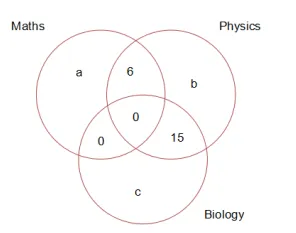
    In a class of 60, along with English as a common subject, students can opt to major in Mathematics, Physics, Biology or a combination of any two. 6 students major in both Mathematics and Physics, 15 major in both Physics and Biology, but no one majors in both Mathematics and Biology. In an English test, the average mark scored by students majoring in Mathematics is 45 and that of students majoring in Biology is 60. However, the combined average mark in English, of students of these two majors, is 50. What is the maximum possible number of students who major ONLY in Physics?

    1. A. 30
    2. B. 25
    3. C. 20
    4. D. 15
    5. E. None of the above
    Answer and solution

    Answer: D

    Solution: Let us note down the information given:
    No person can major in all 3 subjects. 6 students major in both Mathematics and Physics, 15 major in both Physics and Biology, but no one majors in both Mathematics and Biology. There are 60 students in total.


    It has been given that average marks scored by students majoring in Maths in English is 45.
    Average marks scored by students majoring in Biology in English is 60.
    But the combined average marks scored by students majoring in Maths and Biology in English is 50.
    => \(\frac{45 * (a + 6) + 60 * (c + 15)}{a + 6 + c + 15} = 50\)
    \(45a + 270 + 60c + 900 = 50a + 50c + 1050\)
    \(5a = 10c + 120\)
    \(a = 2c + 24\)
    To maximize b, we have to minimize 'a' and 'c'. The least value that 'c' can take is 0.
    The corresponding value of a is 24.
    24+6+b+15 = 60
    => b = 15.
    Therefore, the maximum number of students who could have majored only in physics is 15. Therefore,option D is the right answer.

  11. Question 11

    If \(5^\circ \le x^\circ \le 15^\circ\), then the value of \(\sin 30^\circ + \cos x^\circ - \sin x^\circ\) will be :

    1. A. Between -1 and -0.5 inclusive
    2. B. Between -0.5 and 0 inclusive
    3. C. Between 0 and 0.5 exclusive
    4. D. between 0.5 and 1 inclusive
    5. E. None of the above
    Answer and solution

    Answer: E

    SOLUTION: The value of sin 15° and cos 15° can be found out using the identities sin (A-B) = sin A cos B - cos A sin B and cos (A-B) = cos A cos B + sin A sin B.
    Substituting A = 45° and B = 15° in these expressions, we get,
    sin 15° = 0.2588
    cos 15° = 0.9659

    sin 30° + cos 15° - sin 15° = 0.5 + 0.9659 - 0.2588 = 1.2071.
    None of the given options capture this value in the range. Therefore, option E is the right answer.

  12. Question 12

    The Volume of a pyramid with a square base is 200 cubic cm. The height of the pyramid is 13cm. What will be the length of the slant edges (i.e. the distance between the apex and any other vertex), rounded to the nearest integer?

    1. A. 12 cm
    2. B. 13 cm
    3. C. 14 cm
    4. D. 15 cm
    5. E. 16 cm
    Answer and solution

    Answer: C

    Solution: Volume of the pyramid = \(200\) cubic cm.
    The volume of a pyramid is usually a third of the volume of a cuboid of the same height.
    Therefore, a square cuboid of the height of the pyramid will have a volume of \(600\) cubic cm.

    We know that the height is \(13\) cm.
    Area of the base square* height = \(600\) cm.
    => Area of the base square = \(\frac{600}{13}\) cm\(^2\).
    Side of the base square = \(\sqrt{\frac{600}{13}}\) cm.

    Length of diagonal of the base square = \(\sqrt{\frac{600}{13}} * \sqrt{2}\)

    Now, the height of slant edge of the pyramid can be found out by using the Pythagoras theorem.
    Length of half the diagonal of the base square will form one of the sides and the height of the pyramid will form the other side. The slant height of the pyramid will be the hypotenuse of the right-angled triangle.

    Height of slant edge = \(\sqrt{13^2 + \frac{1}{4} * 2 * \frac{600}{13}}\)
    = \(\sqrt{169 + \frac{600}{26}}\)
    = \(\sqrt{\frac{4394+600}{26}}\)
    = \(\sqrt{\frac{4994}{26}}\)
    =\(\sqrt{192.07}\)
    =\(13.85\) cm
    The nearest integer is \(14\). Therefore, option C is the right answer.

  13. Question 13

    A dice is rolled twice. What is the probability that the number in the second roll will be higher than that in the first?

    1. A. 5/36
    2. B. 8/36
    3. C. 15/36
    4. D. 21/36
    5. E. None of the above
    Answer and solution

    Answer: C

    Solution: A die is rolled twice.
    The number of combinations that can occur = 6*6 = 36.
    We have to find the probability of the second roll being higher than the first.
    If we select 2 numbers out of the 6 and arrange them in ascending order, then we will obtain the scenario in which the number obtained in the second roll will be greater than the number obtained in the first roll.

    2 numbers out of 6 numbers can be selected in 6C2 = 15 ways. The numbers can be arranged in ascending order in only one way.
    Therefore, the required probability is 15/36.

    Therefore, option C is the right answer.

  14. Question 14

    An institute has 5 departments and each department has 50 students. If students are picked up randomly from all 5 departments to form a committee, what should be the minimum number of students in the committee so that at least one department should have representation of minimum 5 students?

    1. A. 11
    2. B. 15
    3. C. 21
    4. D. 41
    5. E. None of the above.
    Answer and solution

    Answer: C

    Solution: We have to employ the pigeon hole principle to solve this problem.
    The maximum number of students who can be picked from each department such that 5 students are not selected from the same department is 4.
    Therefore, after 4 students from each department are selected (i.e., 4*5 = 20 students in total), the 21st student selected will be the fifth student to be selected from one of the 5 departments. Therefore, 20+1 = 21 students should be selected in total to ensure that at least five students from one of the departments is selected.
    Therefore, option C is the right answer.

  15. Question 15

    If \(N = (11^{p+7})(7^{q-2})(5^{r+1})(3^s)\) is a perfect cube, where \(p, q, r\) and \(s\) are positive integers, then the smallest value of \(p + q + r + s\) is :

    1. A. 5
    2. B. 6
    3. C. 7
    4. D. 8
    5. E. 9
    Answer and solution

    Answer: E

    Solution: It has been given that \(N = (11^{p+7})(7^{q-2})(5^{r+1})(3^s)\) is a perfect cube. All the factors given are prime.
    Therefore, the power of each number should be a multiple of 3 or 0.

    \(p, q, r\) and \(s\) are positive integers. Therefore, only the power of the expressions in which some number is subtracted from these variables or these variables are subtracted from some number can be made \(0\).

    \(11^{p+7}\):

    This expression must be made a perfect cube. The nearest perfect cube is \(11^9\). Therefore, the least value that \(p\) can take is \(9 - 7 = 2\).

    \(7^{q-2}\)

    The least value that \(q\) can take is 2. If \(q = 2\), then the value of the expression \(7^{q-2}\) will become \(7^0 = 1\), without preventing the product from becoming a perfect cube.

    \(5^{r+1}\):

    The least value that \(r\) can take is \(2\).

    \(3^s)\):

    The least value that \(s\) can take is \(3\).

    Therefore, the least value of the expression \(p + q + r + s\) is \(2 + 2 + 2 + 3 = 9\).
    Therefore, option E is the right answer.

  16. Question 16

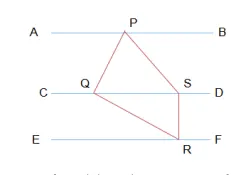
    AB, CD and EF are three parallel lines, in that order. Let d1 and d2 be the distances from CD to AB and EF respectively. d1 and d2 are integers, where d1 : d2 = 2 : 1. P is a point on AB, Q and S are points on CD and R is a point on EF. If the area of the quadrilateral PQRS is 30 square units, what is the value of QR when value of SR is the least?

    1. A. slightly less than 10 units
    2. B. 10 units
    3. C. slightly greater than 10 units
    4. D. slightly less than 20 units
    5. E. slightly greater than 20 units
    Answer and solution

    Answer: E

    Solution: There are 3 parallel lines AB, CD, and EF, in that order.
    Let the distance between CD and AB be 2x.
    It has been given that the distance between CD and EF is x.

    A quadrilateral PQRS is formed such that P is on AB, Q and S are on CD, and R is on EF.
    Also, the length of SR is the least possible value it can take. Therefore, SR must be perpendicular to the parallel lines.

    Area of quadrilateral PQRS = Area of triangle PQS + Area of triangle SRQ = 30 square cm.

    Area of triangle PQS = 2*area of triangle SRQ (Since they rest on the same base and height of SRQ is half the height of PQS)
    => Area of triangle SRQ = 10 square cm.
    Let the length of SQ be \(b\). We know that SR= \(x\)
    \(0.5 * x * s = 10\)
    => \(xs = 20\)
    \(s = 20/x\)
    We do not have any other detail to evaluate the value of the expression. But, we have been given that d1 and d2 are integers. Therefore, the least value that 'x' can take is 1.
    The least value that S can take is 1.
    By Pythagoras theorem, \(QR = \sqrt{s^2 + x^2}\)
    \(QR = \sqrt{20^2 + 1}\)
    \(QR = \sqrt{401}\)
    Therefore, the value of QR will be slightly greater than 20. Therefore, option E is the right answer.

  17. Question 17

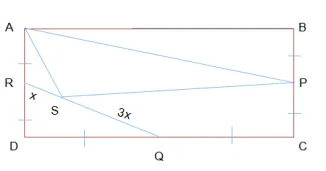
    ABCD is a rectangle. P, Q and R are the midpoint of BC, CD and DA. The point S lies on the line QR in such a way that SR: QS = 1:3. The ratio of the area of triangle APS to area of rectangle ABCD is

    1. A. 36/128
    2. B. 39/128
    3. C. 44/128
    4. D. 48/128
    5. E. 64/128
    Answer and solution

    Answer: A

    Solution: First, let us construct the rectangle using the given information.

    Let the length of the rectangle be 'l' and the breadth of the rectangle be 'b'.
    Area of rectangle ABCD = lb.
    We have to find the area of the triangle APS.
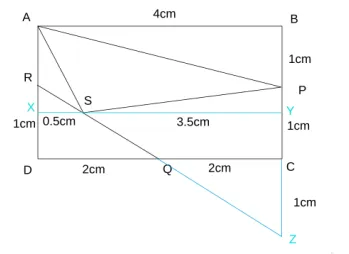
    We consider length as 4cm and breadth as 2cm. ( Answer is irrespective of length and breadth)

    In triangle QRD
    RS/RQ=XS/DQ
    1/4=XS/2cm
    XS= 0.5 cm
    SY= 4cm-0.5cm= 3.5cm

    We can now find the areas of all the sections.
    area (RDQ)= 1/2 x 1cm x 2cm= \(1cm^2\)
    area (ABP) =1/2 x 1cm x 4cm = \(2cm^2\)
    area (ARS) =1/2 x 1cm x 0.5cm = \(0.25cm^2\)
    area (PSQC) = Area (PSZ)-Area(QCZ)= 1/2 x 2cm x 3.5cm - 1/2 x 1cm x 2cm =
    = \(2.5cm^2\)
    Area (ABCD)= 4cm x 2cm = \(8cm^2\)
    Area (APS) = 8 -1 -2 - 0.25 - 2.5 = \(2.25cm^2\)
    Area (APS) / Area (ABCD) = 9/32 = 36/128
    Hence answer (A).

  18. Question 18

    In an innings of a T20 cricket match (a team can bowl for 20 overs) 6 bowlers bowled from the fielding side, with a bowler allowed maximum of 4 overs. Only the three specialist bowlers bowled their full quota of 4 overs each, and the remaining 8 overs were shared among three non-specialist bowlers. The economy rates of four bowlers were 6, 6, 7 and 9 respectively. (Economy rate is the total number of runs conceded by a bowler divided by the number of overs bowled by that bowler). This however, does not include the data of the best bowler (lowest economy rate) and the worst bowler (highest economy rate). The number of overs bowled and the economy rate of any bowler are in integers.

    Read the two statements below:

    S1: The worst bowler did not bowl the minimum number of overs.
    S2: The best bowler is a specialist bowler.


    Which of the above statements or their combinations can help arrive at the minimum number of overs bowled by a non-specialist bowler?

    1. A. S1 only.
    2. B. S2 only.
    3. C. Either S1 or S2.
    4. D. S1 and S2 in combination.
    5. E. The minimum number of overs can be determined without using S1 or S2.
    Answer and solution

    Answer: E

    Solution: Since only the specialist bowlers complete their quota of 4 overs, the maximum over a non-specialist bowler can bowl is three.

    Total number of overs bowled by non-specialist bowlers = 8
    If one of the three bowlers bowls 1 over, the other two will bowl 3 and 4 overs. Since the maximum over a non-specialist bowler can bowl is three, this is an invalid case.
    If one of the non-specialist bowlers bowls 2 overs, the other two will bowl 3 overs each.
    Thus, the minimum a non-specialist bowler can bowl is two overs.
    Since the above calculation did not need either of S1 and S1,
    The correct answer is E.

  19. Question 19

    In an innings of a T20 cricket match (a team can bowl for 20 overs) 6 bowlers bowled from the fielding side, with a bowler allowed maximum of 4 overs. Only the three specialist bowlers bowled their full quota of 4 overs each, and the remaining 8 overs were shared among three non-specialist bowlers. The economy rates of four bowlers were 6, 6, 7 and 9 respectively. (Economy rate is the total number of runs conceded by a bowler divided by the number of overs bowled by that bowler). This however, does not include the data of the best bowler (lowest economy rate) and the worst bowler (highest economy rate). The number of overs bowled and the economy rate of any bowler are in integers.

    Read the two statements below:

    S1. The economy rates of the specialist bowlers are lower than that of the non-specialist bowlers.
    S2. The cumulative runs conceded by the three non-specialist bowlers were 1 more than those conceded by the three specialist bowlers.


    Which of the above statements or their combinations can help arrive at the economy rate of the worst bowler?

    1. A. S1 only.
    2. B. S2 only.
    3. C. Either S1 or S2.
    4. D. S1 and S2 in combination.
    5. E. The economy rate can be calculated without using S1 or S2.
    Answer and solution

    Answer: D

    Solution: As per Statement given paragraph the economy rates are 6,6,7,9 which exclude best bowler and worst bowler
    And Economy rates of specialist bowlers are lower than that of nonspecialist bowlers.

    Let’s take economy rates of specialist bowlers as 5, 6, 6.

    Hence their cumulative runs would be \((5 \times 4) + (6 \times 4) + (6 \times 4) = 68\)
    As per Statement 2, Total runs for non specialist bowlers =69. And their
    economy rates are 7, 9. Let’s take economy rate of worst bowler be x
    \((7 \times 3) + (9 \times 2) + (x \times 3) = 69\)

    => x =10
    For the lowest values of the specialist bowler we take 4. Then value of the worst bowler will be less than 9 which is incorrect.

    Hence only a single case is possible.
    So we can find the economy rate of worst bowler using both the statements.
    Hence answer is option D.

  20. Question 20

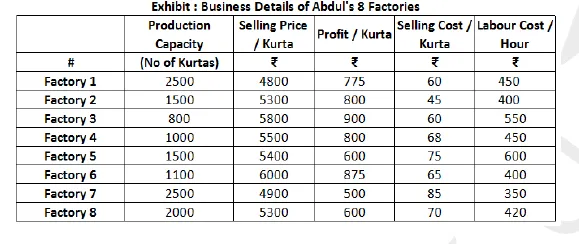
    Abdul has 8 factories, with different capacities, producing boutique kurtas. In the production process, he incurs raw material cost, selling cost (for packaging and transportation) and labour cost. These costs per kurta vary across factories. In all these factories, a worker takes 2 hours to produce a kurta. Profit per kurta is calculated by deducting raw material cost, selling cost and labour cost from the selling price (Profit = selling price - raw materials cost - selling cost - labour cost). Any other cost can be ignored.


    Which of the following options is in decreasing order of raw materials cost per kurta?

    1. A. Factory 3, Factory 4, Factory 7, Factory 5
    2. B. Factory 4, Factory 3, Factory 2, Factory 5
    3. C. Factory 6, Factory 3, Factory 5, Factory 7
    4. D. Factory 6, Factory 8, Factory 7, Factory 2
    5. E. Factory 8, Factory 3, Factory 2, Factory 4
    Answer and solution

    Answer: A

    Solution: Profit = selling price - raw materials cost - selling cost - labor cost

    Hence, raw materials cost = selling price - profit - selling cost - labor cost

    A worker takes 2 hour to produce a kurta.

    Labor cost for Kurta = 2 * (Labor cost/ hour)

    Raw materials cost per Kurta

    for factory 2, 5300-800-45-400*2 = 3655
    for factory 3, 5800-900-60-550*2 = 3740
    for factory 4, 5500-800-68-450*2 = 3732
    for factory 5, 5400-600-75-600*2 = 3525
    for factory 6, 6000-875-65-400*2 = 4260
    for factory 7, 4900-500-85-350*2 = 3615
    for factory 8, 5300-600-70-420*2 = 3790

  21. Question 21

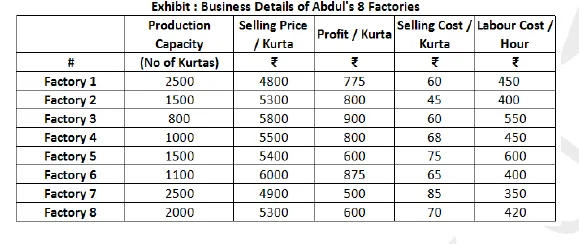
    Abdul has 8 factories, with different capacities, producing boutique kurtas. In the production process, he incurs raw material cost, selling cost (for packaging and transportation) and labour cost. These costs per kurta vary across factories. In all these factories, a worker takes 2 hours to produce a kurta. Profit per kurta is calculated by deducting raw material cost, selling cost and labour cost from the selling price (Profit = selling price - raw materials cost - selling cost - labour cost). Any other cost can be ignored.


    Which of the factories listed in the options below has the lowest sales margin (sales margin = profit per kurta divided by selling price per kurta)?

    1. A. Factory 2
    2. B. Factory 4
    3. C. Factory 5
    4. D. Factory 6
    5. E. Factory 7
    Answer and solution

    Answer: E

    Solution: Sales margin = Profit per kurta/ selling price per kurta
    for factory 2, sales margin = 800/5300 = 0.151
    for factory 4, sales margin = 800/5500 = 0.145
    for factory 5, sales margin = 600/5400 = 0.111
    for factory 6, sales margin = 875/6000 = 0.146
    for factory 7, sales margin = 500/4900 = 0.102
    Factory 7 has lowest sales margin.

  22. Question 22

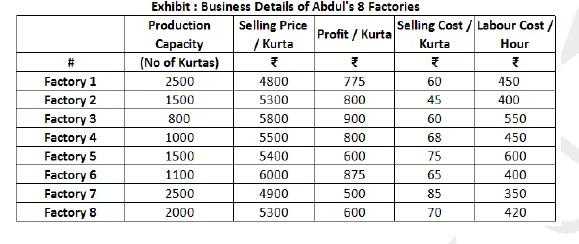
    Abdul has 8 factories, with different capacities, producing boutique kurtas. In the production process, he incurs raw material cost, selling cost (for packaging and transportation) and labour cost. These costs per kurta vary across factories. In all these factories, a worker takes 2 hours to produce a kurta. Profit per kurta is calculated by deducting raw material cost, selling cost and labour cost from the selling price (Profit = selling price - raw materials cost - selling cost - labour cost). Any other cost can be ignored.


    Abdul has received an order for 2,000 kurtas from a big retail chain. They will collect the finished prepackaged kurtas directly from the factories, saving him the selling cost. To deliver this order, he can use multiple factories for production. Which of the following options will ensure maximum profit from this order?

    1. A. Factory 1
    2. B. Factories 2 and 3
    3. C. Factories 4 and 6
    4. D. Factories 3, 6 and 4
    5. E. Factory 1 or Factory 7 or Factory 8
    Answer and solution

    Answer: D

    Solution: Profit = selling price - raw materials cost - selling cost - labor cost

    Since selling cost is zero.

    New Profit = Original Profit + Selling cost

    Profit per Kurta

    for factory 1, 775+60 = 835
    for factory 2, 800+45 = 845
    for factory 3, 900+60 = 960
    for factory 4, 800+68 = 868
    for factory 5, 600+75 = 675
    for factory 6, 875+65 = 940
    for factory 7, 500+85 = 585
    for factory 8, 600+70 = 670

    Arranging all factories in decreasing profits,

    Factory (3>6>4>2>1>5>8>7)

    Factories 3, 6 and 4 will ensure maximum profit.

  23. Question 23

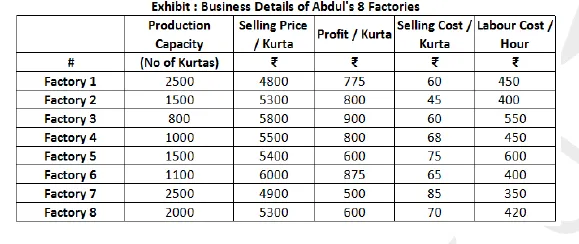
    Abdul has 8 factories, with different capacities, producing boutique kurtas. In the production process, he incurs raw material cost, selling cost (for packaging and transportation) and labour cost. These costs per kurta vary across factories. In all these factories, a worker takes 2 hours to produce a kurta. Profit per kurta is calculated by deducting raw material cost, selling cost and labour cost from the selling price (Profit = selling price - raw materials cost - selling cost - labour cost). Any other cost can be ignored.


    Abdul has introduced a new technology in all his factories. As a result, a worker needs just 1.5 hours to produce a kurta. If raw materials cost and selling cost remain the same, which of the factories listed in the options below will yield the highest profit per kurta?

    1. A. Factory 2
    2. B. Factory 3
    3. C. Factory 4
    4. D. Factory 5
    5. E. Factory 6
    Answer and solution

    Answer: B

    Solution: Profit = selling price - raw materials cost - selling cost - labor cost

    Hence, raw materials cost = selling price - profit - selling cost - labor cost

    Raw materials cost per Kurta

    for factory 2, 5300-800-45-400*2 ....(1)

    After technology is introduced, a worker takes 1.5 hour to produce a kurta.

    Labor cost per Kurta = 1.5 * (Labor cost/ hour)

    New Profit = selling price - raw materials cost - selling cost - new labor cost

    Profit per kurta

    for factory 2 = 5300-(5300-800-45-400*2)-45-400*1.5 = 800 + 400*0.5 = Original Profit per kurta + 0.5*Labour cost per hour

    = 1000

    Similarly,

    for factory 3, 900+550*0.5 = 1175
    for factory 4, 800+450*0.5 = 1025
    for factory 5, 600+600*0.5 = 900
    for factory 6, 875+400*0.5 = 1075

    Factory 3 will yield highest profit.

  24. Question 24

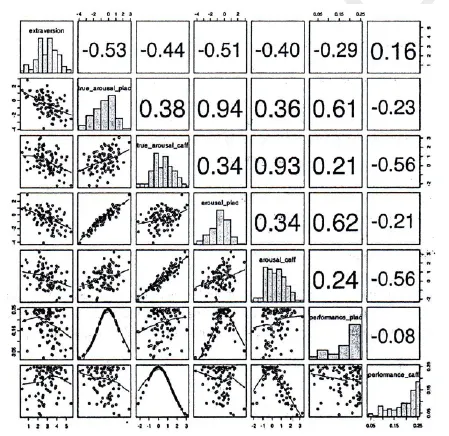
    The grid below captures relationships among seven personality dimensions: "extraversion", "true_arousal_plac", "true_arousal_caff”, "arousal_plac", "arousal_caff”, "performance_plac", and "performance caff”. The diagonal represents histograms of the seven dimensions. Left of the diagonal represents scatterplots between the dimensions while the right of the diagonal represents quantitative relationships between the dimensions. The lines in the scatterplots are closest approximation of the points. The value of the relationships to the right of the diagonal can vary from -1 to +1, with -1 being the extreme linear negative relation and +1 extreme linear positive relation. (Axes of the graph are conventionally drawn).


    Which of the following is true?

    1. A. "Extraversion" has two modes.
    2. B. Median for "arousal_plac" is definitely the same as its average.
    3. C. Median for "arousal_caff" is definitely higher than its average.
    4. D. Median for "performance_plac" is definitely lower than its average.
    5. E. Median for "performance_caff" is definitely lower than its average.
    Answer and solution

    Answer: A


    Solution: Histogram is a graph which depicts the frequency of occurence of values in different ranges.
    For example, lets consider 50 students attended an exam. The distribution of number of students in different score ranges is depicted by the following histogram
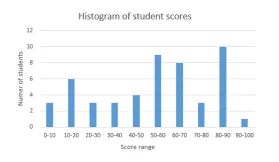

    In this question we have histograms for different personality dimensions.
    However the x and y co-ordinates are not given.
    Since the y co-ordinate gives us frequency/number of occurences of a certain value, we can use a histogram to calculate mean median and mode even without details of x-y co ordinate axes

    Option A : "Extraversion" has 2 modes.

    We can calculate mean of a histogram table by averaging all the values

    We can calculate the median of a histogram table by arranging the histograms in ascending order and the bar/value which is in the middle will get the median.

    Median for "arousal_plac" = -3

    Avergae for "arousal_plac" = (-4-3-2+1+0-3-4)/7 = -15/7 = -2.143

    Median for "arousal_caff" = 0

    Average for "arousal_caff" = (-1.5-1.5+2+1.75+1.5+1.75+1+0-0.5-2-2)/11 = 0.0454

    Median for "performance_plac" = 0.075

    Average for "performance_plac" = (0.025+0.075+0.05+0.1+0.2)/5 = 0.09

    Median for "performance_caff" = 0.075

    Average for "performance_caff" = (0.05+0.25+0.09+0.075+0.08+0.075+0.085+0.1+0.1+0.15+0.18)/11 = 0.1122

  25. Question 25

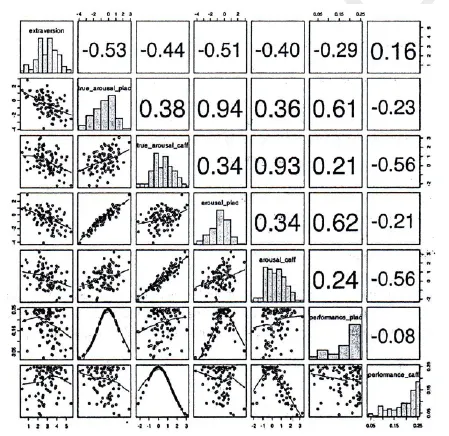
    The grid below captures relationships among seven personality dimensions: "extraversion", "true_arousal_plac", "true_arousal_caff”, "arousal_plac", "arousal_caff”, "performance_plac", and "performance caff”. The diagonal represents histograms of the seven dimensions. Left of the diagonal represents scatterplots between the dimensions while the right of the diagonal represents quantitative relationships between the dimensions. The lines in the scatterplots are closest approximation of the points. The value of the relationships to the right of the diagonal can vary from -1 to +1, with -1 being the extreme linear negative relation and +1 extreme linear positive relation. (Axes of the graph are conventionally drawn).


    Which of the scatterplots shows the weakest relationship?

    1. A. Between "extraversion" and "performance_caff".
    2. B. Between "true_arousal_plac" and "arousal_plac".
    3. C. Between "true_arousal_plac" and "performance_plac".
    4. D. Between "true_arousal_caff" and "performance_caff".
    5. E. Between "arousal_caff" and "performance_caff".
    Answer and solution

    Answer: A

    Answer: A
    Solution: +1 being the extreme linear positive relation and -1 being the extreme linear negative relation. Relationship is weakest when the value is closest to 0.
    Among the given options, A is the weakest.

  26. Question 26

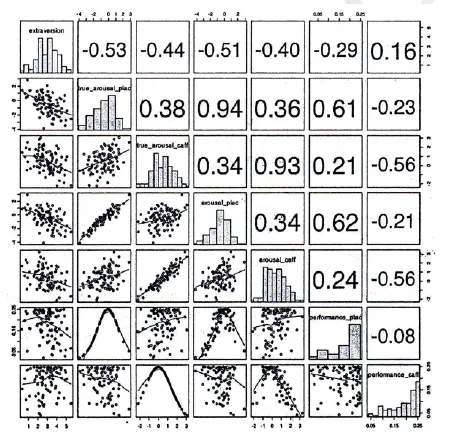
    The grid below captures relationships among seven personality dimensions: "extraversion", "true_arousal_plac", "true_arousal_caff”, "arousal_plac", "arousal_caff”, "performance_plac", and "performance caff”. The diagonal represents histograms of the seven dimensions. Left of the diagonal represents scatterplots between the dimensions while the right of the diagonal represents quantitative relationships between the dimensions. The lines in the scatterplots are closest approximation of the points. The value of the relationships to the right of the diagonal can vary from -1 to +1, with -1 being the extreme linear negative relation and +1 extreme linear positive relation. (Axes of the graph are conventionally drawn).


    In which of the following scatterplots, the value of one dimension can be used to predict the value of another, as accurately as possible?

    1. A. "extraversion" and "true_ arousal_caff'
    2. B. "true_arousal_plac" and “arousal_plac"
    3. C. "true_arousal_plac" and "performance_plac"
    4. D. "true_arousal_plac" and "performancc_caff"
    5. E. All the above are irrelevant relations.
    Answer and solution

    Answer: C

    Solution: Scatterplot between "true_arousal_plac" and "performance_plac" is least scattered, which shows strong relationship between two dimensions.

  27. Question 27

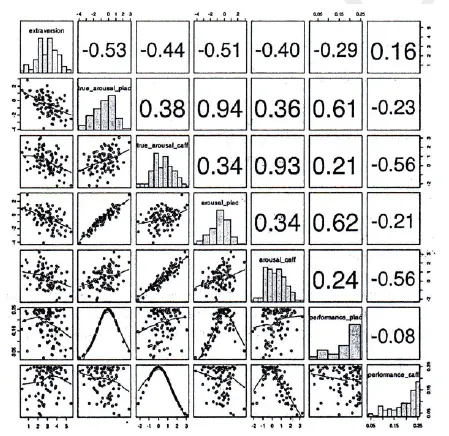
    The grid below captures relationships among seven personality dimensions: "extraversion", "true_arousal_plac", "true_arousal_caff”, "arousal_plac", "arousal_caff”, "performance_plac", and "performance caff”. The diagonal represents histograms of the seven dimensions. Left of the diagonal represents scatterplots between the dimensions while the right of the diagonal represents quantitative relationships between the dimensions. The lines in the scatterplots are closest approximation of the points. The value of the relationships to the right of the diagonal can vary from -1 to +1, with -1 being the extreme linear negative relation and +1 extreme linear positive relation. (Axes of the graph are conventionally drawn).


    Which of the following options is correct?

    1. A. 0.93 on the right side of the diagonal corresponds to the third scatterplot in the fourth row.
    2. B. 0.94 on the right side of the diagonal corresponds to the second scatterplot in the fourth row.
    3. C. 0.38 is the relationship between "extraversion" and "true_arousal_plac".
    4. D. "arousal_catr” and "performance_caff" arc positively related.
    5. E. The line that captures relationship between "arousal_caff" and "arousal_plac" can be denoted by equation: y-= a-bx, where b>0.
    Answer and solution

    Answer: B

    Solution: 0.94 is quantitative relationship between true_arousal_plac and arousal_plac. Scatterplot that shows this relationship is the second one in fourth row on the left side of the diagonal.

Practise these questions one at a time, with instant answers

Marking & rules

Total marks
27 across 27 questions.
Negative marking
A wrong answer costs marks. Leaving a question unanswered costs nothing.
Attempts
100 in total. An attempt is spent the moment you begin one.

What you get when you submit

The analysis is ready the moment you submit the paper.

Score and accuracy

Marks, percentage, right, wrong and skipped, and the time you took.

Section by section

The same figures for each section, so a weak one cannot hide in an average.

The full answer key

Every question with your answer, the right one, the working, and the video where there is one.

Where you stand

Your score against the spread of everyone else who has sat this test.

Chat with an academic counsellor on WhatsApp