
Skip to content
Aptitude360

Arithmetic Problems (CAT PYQs) Part - 2

50 questions. Choose an option and see at once whether it was right, with the correct answer and a worked solution. No timer, and nothing to submit.

0 of 50 answered

0 correct0 wrong

  1. Question 1

    Directions for Questions : Answer the following questions based on the information given below: Cities A and B are in different time zones. A is located 3000 km east of B. The table below describes the schedule of an airline operating non-stop flights between A and B. All the times indicated are local and on the same day
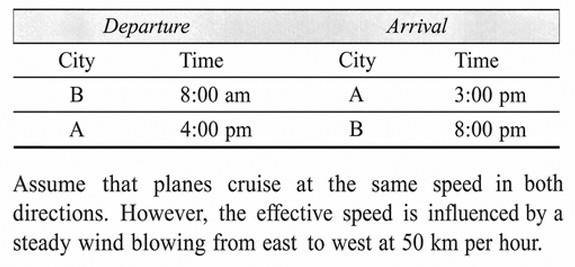

    What is the plane's cruising speed in km per hour?

  2. Question 2

    Directions for Questions : Answer the following questions based on the information given below: Mr. David manufactures and sells a single product at a fixed price in a niche market. The selling price of each unit is ₹30. On the other hand the cost, in rupees, of producing 'x' units is 240 + bx + cx², where 'b' and 'c' are some constants. Mr. David noticed that doubling the daily production from 20 to 40 units increases the daily production cost by 66.66%. However, an increase in daily production from 40 to 60 units results in an increase of only 50% in the daily production cost. Assume that demand is unlimited and that Mr. David can sell as much as he can produce. His objective is to maximize the profit.

    How many units should Mr. David produce daily?

  3. Question 3

    Directions for Questions: Answer the following questions based on the information given below: Mr. David manufactures and sells a single product at a fixed price in a niche market. The selling price of each unit is ₹30. On the other hand the cost, in rupees, of producing 'x' units is 240 + bx + cx², where 'b' and 'c' are some constants. Mr. David noticed that doubling the daily production from 20 to 40 units increases the daily production cost by 66.66%. However, an increase in daily production from 40 to 60 units results in an increase of only 50% in the daily production cost. Assume that demand is unlimited and that Mr. David can sell as much as he can produce. His objective is to maximize the profit.

    What is the maximum daily profit, in rupees, that Mr. David can realize from his business?

  4. Question 4

     A shop stores x kg of rice. The first customer buys half this amount plus half a kg of rice. The second customer buys half the remaining amount plus half a kg of rice. Then the third customer also buys half the remaining amount plus half a kg of rice. Thereafter, no rice is left in the shop. Which of the following best describes the value of x?

  5. Question 5

     In a survey of political preferences, 78 per cent of those asked, were in favour of at least one of the proposals I, II and III. 50 per cent of those asked favoured proposal I, 30 per cent favoured proposal II and 20 per cent favoured proposal III. If 5 per cent of those asked favoured all the three proposals, what percentage of those asked favoured more than one?

  6. Question 6

     A student took five papers in an examination, where the full marks were the same for each paper. His marks in these papers were in the proportion of 6:7:8:9:10. In all papers together, the candidate obtained 60 per cent of the total marks. Then the number of papers in which he got more than 50 per cent marks is:

  7. Question 7

    Every 10 years the Indian government counts all the people living in the country. Suppose that the director of the census has reported the following data on two neighbouring villages—ChotaHazri and MotaHazri. ChotaHazri has 4,522 fewer males than MotaHazri. MotaHazri has 4,020 more females than males. ChotaHazri has twice as many females as males. ChotaHazri has 2,910 fewer females than MotaHazri. What is the total number of males in ChotaHazri?

  8. Question 8

    Shyama and Vyom walk up an escalator (moving stairway). The escalator moves at a constant speed. Shyama takes three steps for every two of Vyom's steps. Shyama gets to the top of the escalator after having taken 25 steps, while Vyom (because her slower pace lets the escalator do a little more of the work) takes only 20 steps to reach the top. If the escalator were turned off, how many steps would they have to take to walk up?

  9. Question 9

    A can complete a piece of work in 4 days. B takes double the time taken by A. C takes double that of B, and D takes double that of C to complete the same task. They are paired in groups of two each. One pair takes two-thirds the time needed by the second pair to complete the work. Which is the first pair?

  10. Question 10

    A lot of work remains while preparing a birthday dinner. Even after the turkey is in the oven, there are still the potatoes and gravy, yams, salad, and cranberries, not to mention setting the table. Three friends, Asit, Arnold and Afzal work together to get all of these chores done. The time it takes them to do the work together is six hours less than Asit would have taken working alone, one hour less than Arnold would have taken alone, and half the time Afzal would have taken working alone. How long did it take them to do these chores working together?

Chat with an academic counsellor on WhatsApp