
SNAP Syllabus 2026: Complete Section-Wise Topics, Weightage & Preparation Guide
SNAP 2026 syllabus explained section-wise — General English, Quantitative Ability, Logical Reasoning, and the newly added Ethics, Morality and Values section. Covers exact question-wise weightage, topic-level breakdown, and a priority-based preparation strategy based on the revised 10-20-20-10 exam pattern, helping MBA aspirants target high-scoring topics first.

Amit Kumar JaiswalAuthor
7 min read
- Last updated
- 9 Sept 2026
- Length
- 2,042 words

Every year around July-August, we see the same question flood in at Aptitude360 — "I've decided to attempt SNAP, but where do I even start with the syllabus?" This year, that question has an extra layer to it, because SNAP 2026 isn't the same three-section exam most seniors and older study material describe. SIU has revised the pattern and added a brand-new fourth section — Ethics, Morality and Values — which means even students who've been casually following SNAP prep material from last year need to recalibrate before they start.
Having taken hundreds of students through SNAP prep at our Sector 34A centre, here's the exact, verified breakdown we're using with our own 2026 batches — section by section, topic by topic, with the actual weightage changes factored in.
SNAP 2026 Syllabus: What Changed From Last Year
Before anything else, let's get the structural change out of the way, because it affects how you should be splitting your prep time from day one.
| Section | SNAP 2025 (Old Pattern) | SNAP 2026 (Revised Pattern) |
|---|---|---|
| General English | 15 questions | 10 questions |
| Analytical & Logical Reasoning | 25 questions | 20 questions |
| Quantitative, DI & Data Sufficiency | 20 questions | 20 questions |
| Ethics, Morality and Values | Not present | 10 questions (New) |
| Total | 60 questions | 60 questions |
Total questions, total marks (60), and the 60-minute no-sectional-time format all stay the same. What's changed is that English lost 5 questions and Reasoning lost 5 questions to make room for the new Ethics section. If you started your SNAP prep before this cycle's notification, or you're using a friend's older material, this is exactly the kind of gap we correct on day one with every new batch — because prepping for a 25-question Reasoning section when it's actually 20 questions this year means your time allocation is already off before you've solved a single mock.
SNAP 2026 Full Exam Pattern: Section-Wise Weightage
Here's the complete picture of how this year's 60 questions are actually distributed.
| Section | Number of Questions | Marks | Marking Scheme |
|---|---|---|---|
| General English | 10 | 10 | +1 correct, -0.25 wrong |
| Analytical & Logical Reasoning | 20 | 20 | +1 correct, -0.25 wrong |
| Quantitative, DI & Data Sufficiency | 20 | 20 | +1 correct, -0.25 wrong |
| Ethics, Morality and Values | 10 | 10 | +1 correct, -0.25 wrong |
| Total | 60 | 60 | — |
Analytical & Logical Reasoning and Quantitative Ability now sit level at 20 questions each, effectively sharing the top weightage spot — a genuine shift from previous years when Reasoning alone dominated the paper. This is a change we specifically walk new students through, because a lot of pre-2026 SNAP strategy content built around "Reasoning is your biggest section" simply doesn't hold the same way it did last cycle.
SNAP Quantitative Ability, DI & DS Syllabus: Topics You Need to Master
This section still carries 20 questions and tests mathematical aptitude, analytical thinking, and data-handling skills. Based on how this section has actually played out over the past several years, Arithmetic and Modern Mathematics dominate, with Data Interpretation and Data Sufficiency forming a smaller, more predictable chunk.
| Main Topic | Subtopics |
|---|---|
| Arithmetic | Percentages, Profit and Loss, Simple Interest, Compound Interest, Ratio and Proportion, Averages, Time-Speed-Distance, Time and Work, Mixtures and Alligation |
| Modern Mathematics | Permutation and Combination, Probability, Sequences and Series |
| Algebra | Linear and Quadratic Equations, Inequalities |
| Geometry & Mensuration | Lines, Angles and Polygons, Triangles, Circles, Mensuration (2D and 3D) |
| Number System | LCM & HCF, Divisibility, Remainders |
| Data Interpretation | Bar Graphs, Pie Charts, Line Graphs, Tables |
| Data Sufficiency | Statement-based sufficiency questions |
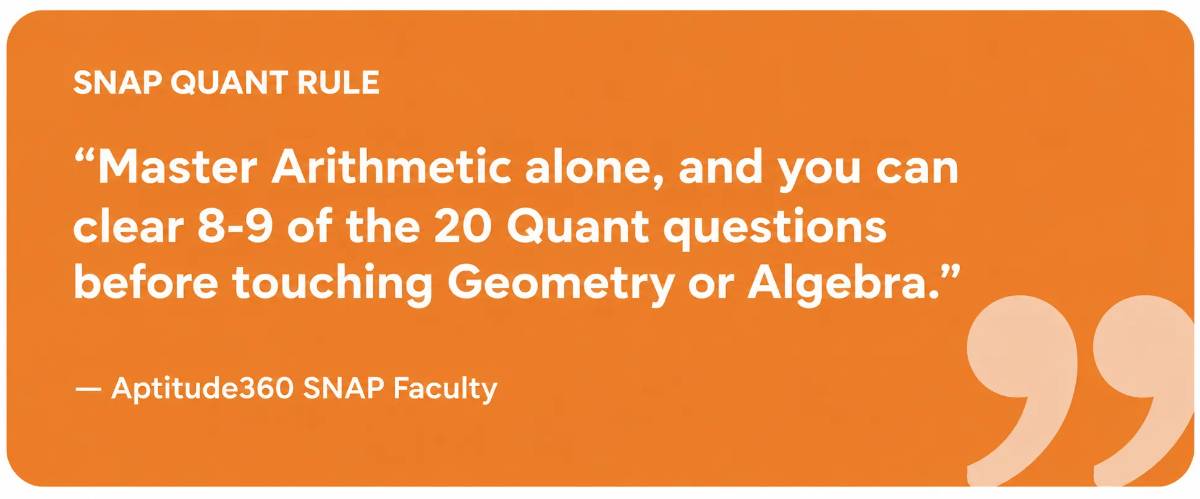
Here's a concrete example we use in class to explain why Arithmetic deserves the first slot in your prep calendar: take a typical SNAP quant set of 20 questions — in most recent years, 8 to 10 of those have come directly from Arithmetic sub-topics like percentages, profit-loss, and time-speed-distance, with Data Interpretation contributing maybe 3 to 4 questions tied to a single graph or table. A student who's simply fast and accurate at percentage-based calculations is already positioned to comfortably clear 8-9 questions in this section alone, before even opening a Geometry or Algebra problem. That's the kind of return-on-effort we push students toward first.
SNAP General English Syllabus: What Actually Gets Tested
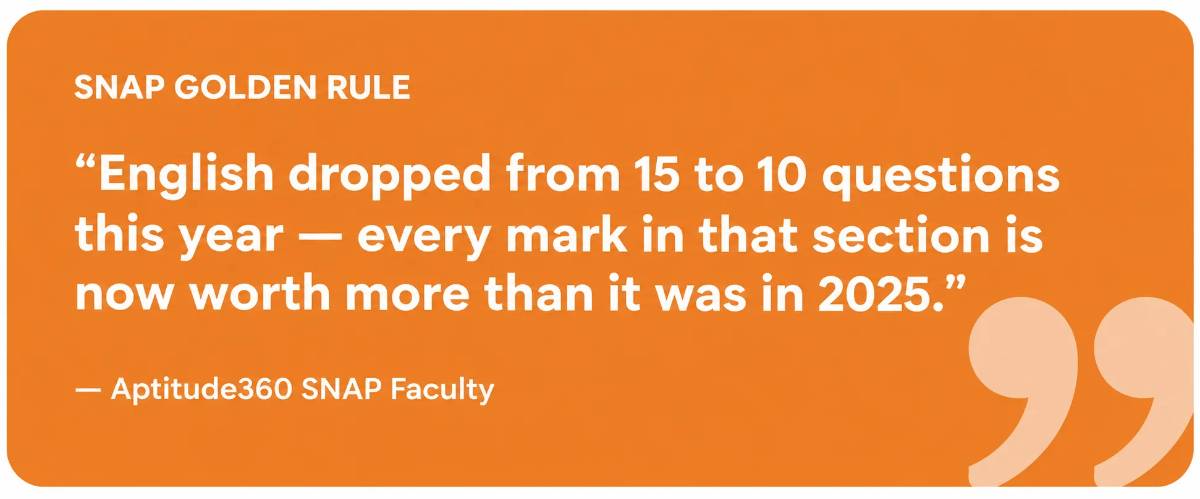
General English now carries 10 questions instead of last year's 15 — still a section students generally feel comfortable walking into, but a smaller one this year, which changes how much time it deserves relative to the others.
| Focus Area | Subtopics |
|---|---|
| Verbal Ability | Synonyms & Antonyms, Idioms & Phrases, One-word Substitution, Compound Words |
| Grammar | Sentence Correction, Fill in the Blanks, Error Spotting |
| Sentence Logic | Para Jumbles |
| Reading Comprehension | Short passages (part of the syllabus, though asked less frequently in recent years) |
Reading Comprehension is technically part of SNAP's syllabus, but it has barely featured in the last few years' papers, with the section leaning far more heavily toward vocabulary, grammar, and para jumbles. We still tell students not to skip RC practice entirely — SIU can bring it back without warning, and this year's pattern revision is proof that SIU is willing to change things up — but with only 10 questions now on the table for this entire section, vocabulary and grammar accuracy matter more than ever, since there's less room to make up lost ground elsewhere within English itself.
SNAP Analytical & Logical Reasoning Syllabus: Still a Core-Weightage Section
With 20 out of 60 questions, Reasoning now shares the top weightage spot with Quant rather than sitting alone at the top — but it remains one of the two sections we spend the most classroom time on with our own batches.
| Focus Area | Subtopics |
|---|---|
| Arrangements & Puzzles | Linear and Circular Arrangement, Scheduling, Distribution |
| Critical Reasoning | Statement-Conclusion, Cause & Effect, Assumptions, Course of Action, Syllogisms |
| Series & Coding | Coding-Decoding, Number Series, Letter Series, Missing Terms, Input-Output |
| Miscellaneous | Blood Relations, Direction Sense, Clocks & Calendars, Analogies, Venn Diagrams |
The good news here is that this section's individual questions tend to sit in the "easy to moderate" range rather than requiring the kind of layered, multi-step reasoning CAT's DILR section demands. The challenge isn't depth — it's building enough speed to comfortably clear 15-16 of the 20 questions within your allotted share of the 60-minute window. As an example we use with students: a typical seating arrangement puzzle here might involve 5-6 people around a circular table with 3-4 conditions — solvable in under 90 seconds once you've drilled the format enough times, but it can easily eat 4-5 minutes for someone attempting this puzzle type for the first time under exam pressure.
SNAP Ethics, Morality and Values Syllabus: The New Section, Explained
This is the section generating the most questions from our students right now, simply because there's no previous-year SNAP paper to study from — SIU has introduced it fresh for 2026. It carries 10 questions worth 10 marks, with the same +1/-0.25 marking scheme as every other section.
Based on the official notification and how similar ethics-based sections have been structured in other management exams, here's the topic spread we're preparing our students on:
| Topic Area | What It Covers |
|---|---|
| Ethical Foundations | Values, morals, ethics and law — how they differ; personal versus professional ethics; duty versus consequence |
| Corporate Governance | Board responsibility, transparency and disclosure, conflict of interest, whistleblowing, insider trading |
| Workplace Conduct | Fairness in hiring and promotion, discrimination and harassment, employee rights, workplace safety |
| Diversity, Equity & Inclusion | Bias awareness, inclusion of employees across backgrounds, equal opportunity |
| Data & Digital Ethics | Customer data privacy, confidentiality of company information, responsible use of technology |
| Stakeholder Responsibility | Shareholder versus stakeholder interest, honest advertising, supplier and community obligations |
| Sustainability & CSR | Environmental responsibility, corporate social responsibility, ethical sourcing |
| Situational Judgment | Everyday workplace dilemmas requiring you to weigh competing obligations and pick the most responsible course of action |
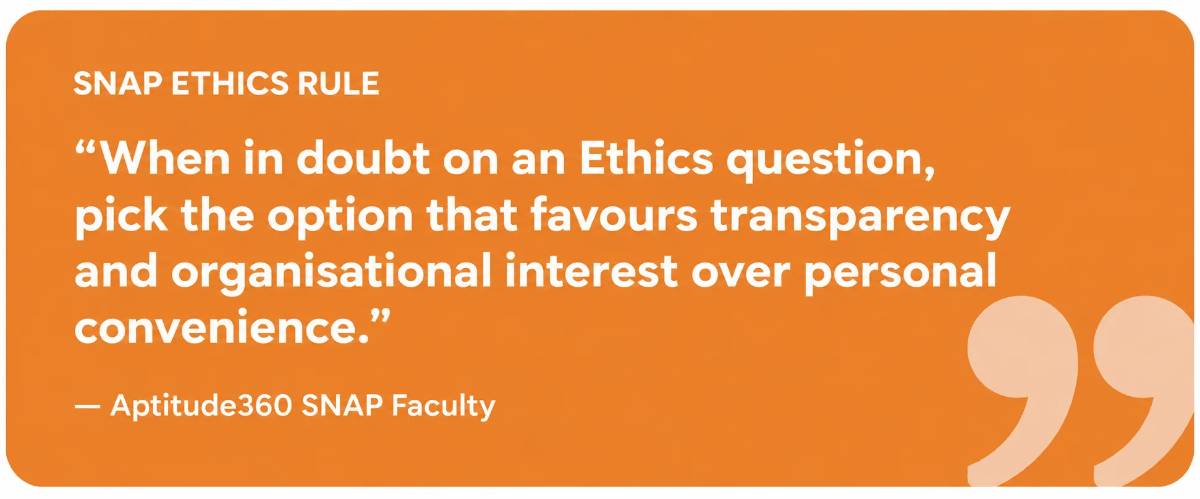
Here's a concrete example of the kind of scenario this section is expected to test: you're told an employee's close relative has applied for an open position on their team, and you're asked to identify the most appropriate response — the "correct" answer typically leans toward disclosure and stepping back from the hiring decision, prioritising organisational fairness over personal convenience. There's no formula here, but there is a discernible pattern — questions consistently reward the response that favours transparency, fairness, and long-term organisational interest over shortcuts or personal gain.
Since this section is worth the same 10 marks as English but is entirely unfamiliar territory for most aspirants, our advice to students is straightforward: don't over-invest prep time chasing every possible ethics topic. Get comfortable with the core vocabulary — terms like corporate governance, CSR, DEI, whistleblowing, conflict of interest — and practice applying basic fairness-and-transparency logic to workplace scenarios. That's enough to comfortably clear 6-7 of these 10 questions without it eating into the far larger time budget Quant and Reasoning deserve.
SNAP 2026 Important Topics: Where to Focus If You're Short on Time
If you're starting SNAP prep late or juggling it alongside CAT, here's the priority order we give students who don't have the luxury of covering every topic exhaustively:
- Arithmetic — percentages, profit-loss, time-speed-distance (highest-frequency topic in Quant)
- Logical reasoning puzzles and seating arrangement (still core-weightage even after losing 5 questions)
- Ethics core vocabulary and situational judgment — corporate governance, CSR, DEI, whistleblowing (new section, low prep cost for decent returns)
- Grammar and vocabulary basics over Reading Comprehension in English (based on recent paper trends)
- Data Interpretation sets — bar, pie, and line graphs
- Coding-decoding and syllogisms
This isn't a shortcut to skip full preparation — it's where your first few weeks of prep time earn the most marks per hour invested, which matters a great deal when SNAP prep season often overlaps with CAT's final stretch.
How to Prepare for SNAP Syllabus 2026: A Realistic Approach
Once you know what's actually being tested, the preparation itself needs structure, not just topic coverage.
Start by mapping your existing CAT or general aptitude prep against this syllabus — most students already have a working base in Arithmetic, basic Algebra, and common Reasoning topics, so the real work for those three sections is filling specific gaps rather than starting from zero. The one genuinely new piece of work is Ethics, Morality and Values, and here we tell students to treat it almost like a current-affairs subject — 15-20 minutes a day reading about real corporate governance and workplace fairness cases does more for this section than hours of formula-based practice ever would.
Mock tests matter more for SNAP than most aspirants realise, specifically because of the no-sectional-time format. With four sections now competing for the same 60 minutes instead of three, deciding your own attempt order — and how many minutes to genuinely allocate to the new Ethics section versus your stronger Quant or Reasoning sections — has become a more complex decision than it was last year. That's not something you can plan on paper; it only comes from attempting full-length, correctly-timed mocks built on this year's actual four-section pattern.
Preparing for SNAP Syllabus in Chandigarh and the Tricity Region
If you're based in Chandigarh, Mohali, or Panchkula and are mapping out your SNAP preparation, this pattern change has become one of the most common starting-point questions we've fielded at our Sector 34A centre this prep season.
Being close to the ISBT and PGI stretch makes the commute manageable for students coming in from across Mohali and Panchkula, and the PG and food options around Sector 34 make it easier for out-of-town students who relocate to Chandigarh specifically for exam prep.
Because Ethics, Morality and Values has no previous-year papers to draw from, our SNAP batches have built a dedicated short module for it — covering core terminology and situational-judgment practice — rather than treating it as an afterthought squeezed into general classes, which is how we've seen several students elsewhere approach it simply because it's unfamiliar. Our mock series has also already been rebuilt around this year's actual four-section, 10-20-20-10 pattern, so students walk in practicing time allocation against the real exam structure rather than an outdated one.
Whether you're preparing online, offline, or in a hybrid mode, our approach at Aptitude360 stays consistent — teach the syllabus the way SNAP is actually testing it this year, not the way last year's material still describes it.
Online, offline or hybrid
See Where Your Preparation Stands
With a Free Demo or Assessment
Book a demo class or take our assessment test to check your current preparation level. Both are free, with no obligation.
Aptitude360 centre: 3rd Floor, SCO 80–82, Sector 34A, Chandigarh 160022. Directions and contact