
XAT 2023 QADI
Q1–10 of 28Amit has forgotten his 4-digit locker key. He remembers that all the digits are positive integers and are different from each other. Moreover, the fourth digit is the smallest and the maximum value of the first digit is 3. Also, he recalls that if he divides the second digit by the third digit, he gets the first digit. How many different combinations does Amit have to try for unlocking the locker?
Explanation:
(Remember, 0 is neither positive nor negative)
So the following are the possible different values that the first and fourth digits can take…
The maximum value that the first digit can take is 3. The fourth digit is the smallest.
If he divides the second digit by the third digit, he gets the first digit.
Case 1) If the first digit is 3.
The second digit is 3 times the third digit.
The possible pairs are…
(3, 1), (6, 2), (9, 3)
Since all the digits are distinct, only (6,2) works and it works only if the fourth digit is 1
Case 2) If the first digit is 2.
The second digit is 2 times the third digit..
The possible pairs are…
(2, 1), (4, 2), (6, 3), (8, 4)
Since all the digits are distinct, only (6, 3) and (8, 4) work.
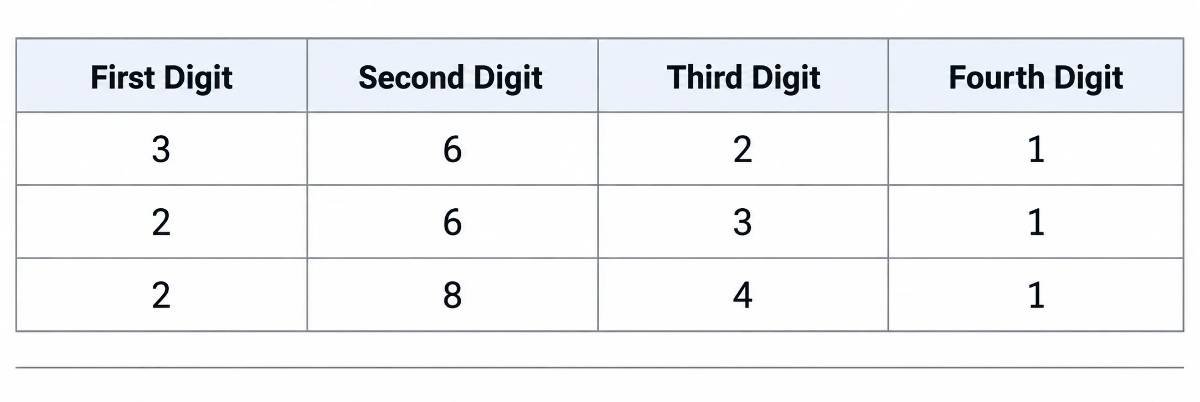
Choice E is the correct answer.
The problem below consists of a question and two statements numbered 1 & 2.
You have to decide whether the data provided in the statements are sufficient to answer the question.
Rahim is riding upstream on a boat, from point A to B, at a constant speed. The distance from A to B is 30 km. One minute after Rahim leaves from point A, a speedboat starts from point A to go to point B. It crosses Rahim’s boat after 4 minutes. If the speed of the speedboat is constant from A to B, what is Rahim’s speed in still water?
1. The speed of the speedboat in still water is 30 km/hour.
2. Rahim takes three hours to reach point B from point A.
Explanation:
Let the speed of Rahim in still water be ‘R’ kmph.
Let the speed of the Speed Boat in still water be ‘S’ kmph.
Let the speed of the stream be ‘a’ kmph.
“One minute after Rahim leaves from point A, a speedboat starts from point A to go to point B. It crosses Rahim’s boat after 4 minutes.”
This means, when both of them were travelling upstream, the time taken by the Speed Boat and Rahim to reach the same point is 4 mins and 5 mins respectively. This means their speeds are in the ratio 5 : 4 when they travel upstream.
S−aR−a=54
Statement 1: The speed of the speedboat in still water is 30 km/hour.
S = 30
30−aR−a=54
This piece of information on its own doesn’t solve our problem.
Statement 2: Rahim takes three hours to reach point B from point A.
This means Rahim’s upstream speed is 303=10kmph
R - a = 10
S−a10=54
This piece of information on its own doesn’t solve our problem.
But when we club both the statements…
30−a10=54
4(30−a)=50
120−4a=50
a=17.5
WKT, R - a = 10
R - 17.5 = 10
R = 27.5 kmph
Technically, this question is not solvable… We are assuming that the Speed Boat crosses Rahim before he reaches point B. If the Speed Boat crosses Rahim after he reaches point B (that is, when he is stationary), we can’t say that the ratio of their upstream speeds is 5 : 4.
Choice D is the correct answer.
Rajnish bought an item at 25% discount on the printed price. He sold it at 10% discount on the printed price.
What is his profit in percentage?
Explanation:
Let’s assume that the printed price is ₹ 100.
Cost Price = 25% discount on the printed price = ₹ 75.
Selling Price = 10% discount on the printed price = ₹ 90.
Profit = SP - CP = ₹ 90 - ₹ 75 = ₹ 15
\(\frac{15}{75}\times 100 = 20\%\)
Choice D is the correct answer.
The problem below consists of a question and two statements numbered 1 & 2.
You have to decide whether the data provided in the statements are sufficient to answer the question.
In a cricket match, three slip fielders are positioned on a straight line. The distance between 1st slip and 2nd slip is the same as the distance between 2nd slip and the 3rd slip. The player X, who is not on the same line of slip fielders, throws a ball to the 3rd slip and the ball takes 5 seconds to reach the player at the 3rd slip. If he had thrown the ball at the same speed to the 1st slip or to the 2nd slip, it would have taken 3 seconds or 4 seconds, respectively. What is the distance between the 2nd slip and the player X?
1. The ball travels at a speed of 3.6 km/hour.
2. The distance between the 1st slip and the 3rd slip is 2 meters.
Solution:
None from this
Given \(A = |x+3| + |x-2| - |2x-8|\).
The maximum value of |A| is:
Solution:
B. 9
ABC is a triangle with BC = 5 .D is the foot of the perpendicular from A on BC. E is a point on CD such that BE=3. The value of \(AB^2 - AE^2\)−AE2+6CD is:
Explanation:
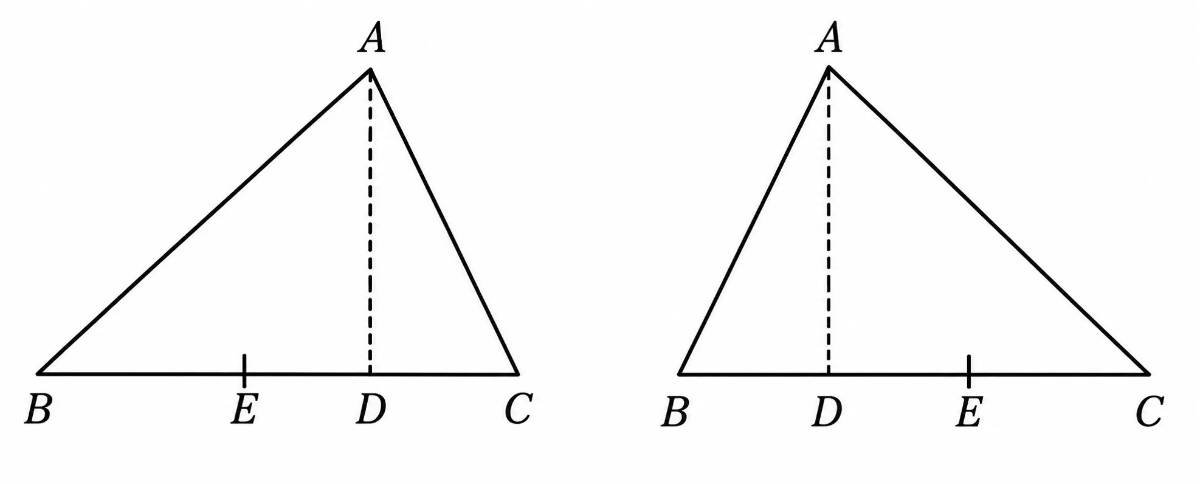
\[
\begin{aligned}
AB^2 - AE^2 + 6CD
&= (BD^2 + AD^2) - (AD^2 + DE^2) + 6CD \\
&= BD^2 - DE^2 + 6CD \\
&= BD^2 - |3 - BD|^2 + 6(5 - BD) \\
&= BD^2 - (9 - 6BD + BD^2) + 30 - 6BD \\
&= BD^2 - 9 + 6BD - BD^2 + 30 - 6BD \\
&= 30 - 9 \\ &= 21
\end{aligned}
\]
Choice E is the correct answer.
The addition of 7 distinct positive integers is 1740.
What is the largest possible “greatest common divisor” of these 7 distinct positive integers?
Explanation:
Let the GCD of the 7 different positive numbers be x.
Then the sum of these 7 integers is at least 28x.
The positive integers could be x, 2x, 3x, 4x, 5x, 6x, 7x
In this case The sum of the 7 integers is \[ x \times \frac{7(7+1)}{2} = 28x \]
In any other case, the sum will be some N×y where y is the GCD and N is greater than 28.
Realize that the sum is fixed,
1740=28x=N×y
So, the maximum value of the GCD occurs when N is as close to 28 as possible.
(1740 is not a multiple of 28.)
29 is a multiple of 1740.
When N = 29, y = 60
Choice B is the correct answer.
Jose borrowed some money from his friend at simple interest rate of 10% and invested the entire amount in stocks. At the end of the first year, he repaid 1/5th of the principal amount. At the end of the second year, he repaid half of the remaining principal amount. At the end of third year, he repaid the entire remaining principal amount. At the end of the fourth year, he paid the last three years’ interest amount. As there was no principal amount left, his friend did not charge any interest in the fourth year. At the end of fourth year, he sold out all his stocks. Later, he calculated that he gained Rs. 97500 after paying principal and interest amounts to his friend. If his invested amount in the stocks became double at the end of the fourth year, how much money did he borrow from his friend?
Solution:
D. 125000
The Guava club has won 40% of their football matches in the Apple Cup that they have played so far. If they play another n matches and win all of them, their winning percentage will improve to 50. Further, if they play 15 more matches and win all of them, their winning percentage will improve from 50 to 60. How many matches has the Guava club played in the Apple Cup so far? In the Apple Cup matches, there are only two possible outcomes, win or loss; draw is not possible.
Explanation:
Let the initial number of matches played be x.
By playing and winning n more matches, the winning percentage increases to 50%.
0.4x+n=0.5×(n+x)
0.4x+n=0.5n+0.5x
0.5n=0.1x
5n=x
By playing and winning 15 more matches, the winning percentage increases to 60%.
0.4x+n+15=0.6×(15+n+x)
3n+15=9+3.6n
0.6n=6
n=10
x=5n=50
Choice A is the correct answer.
Find the value of: \[
\frac{\sin^6 15^\circ+\sin^6 75^\circ+6\sin^2 15^\circ\sin^2 75^\circ}
{\sin^4 15^\circ+\sin^4 75^\circ+5\sin^2 15^\circ\sin^2 75^\circ}
\]
Explanation:
\[ \begin{aligned} \frac{\sin^6 15^\circ+\sin^6 75^\circ+6\sin^2 15^\circ\sin^2 75^\circ} {\sin^4 15^\circ+\sin^4 75^\circ+5\sin^2 15^\circ\sin^2 75^\circ} &= \frac{\sin^6 15^\circ+\cos^6 15^\circ+3\sin^2 15^\circ\cos^2 15^\circ(\sin^2 15^\circ+\cos^2 15^\circ)+3\sin^2 15^\circ\sin^2 75^\circ} {\sin^4 15^\circ+\cos^4 15^\circ+2\sin^2 15^\circ\cos^2 15^\circ(\sin^2 15^\circ+\cos^2 15^\circ)+3\sin^2 15^\circ\sin^2 75^\circ} \\[4pt] &= \frac{(\sin^2 15^\circ+\cos^2 15^\circ)^3+3\sin^2 15^\circ\sin^2 75^\circ} {(\sin^2 15^\circ+\cos^2 15^\circ)^2+3\sin^2 15^\circ\sin^2 75^\circ} \\[4pt] &= \frac{1+3\sin^2 15^\circ\sin^2 75^\circ} {1+3\sin^2 15^\circ\sin^2 75^\circ} \\[4pt] &=1 \end{aligned} \]
Choice C is the correct answer.