
XAT 2023 BDM
Q1–10 of 22Read the following scenario and answer the questions that follow.
During the floods of 2018-2019, a group of philanthropists led by Niyabuddin, wished to open free food centre for the needy. Their motto was that “no human should be hungry.” Nothing gives more satisfaction to the philanthropists than to see the hungry eat to the fullest.
Post Covid-19, the group started a food centre by the name Win Borne Life Care Food (WBLCF) in a small town called Palakkad. The centre started gaining popularity as the number of people enjoying free meals increased over time. Initially, WBLCF offered a standardized menu consisting of idli, upma, puttu for breakfast, curd rice for lunch, and idli or upma for supper. Six women were employed by WBLCF to prepare all the meals. As the number of diners increased, they started expecting a variety in the menu.
At WBLCF, not all the diners eat "free": while two-thirds of diners get free food, one-third would donate some amount to a transparent charity box kept at the entrance. For example, a man donated Rs. 500 after consuming two idlis, and a woman approached Niyabuddin and inquired about donating 10 kilogrammes of rice. Those who could not afford to donate, were often seen prostrating worshipfully in front of the charity box.
Some caring individuals made monetary donation while others donated rice, fruits and vegetables to WBLCF. Further, the centre received enquiries from many locals on how they could contribute to the cause.
As the centre was lauded for its philanthropic work by people of the town, Niyabuddin intended to replicate the initiative in the nearby districts. However, he is concerned about the cost that goes into running the centre. Almost 75 percent of the donated amount goes into buying the cooking ingredients, while the rest goes into paying salaries, operations and maintenance costs.
From the following, choose the MOST important challenge that Niyabuddin has to overcome to sustain WBLCF.
Solution:
D. Getting enough finances and donations
Read the following scenario and answer the questions that follow.
During the floods of 2018-2019, a group of philanthropists led by Niyabuddin, wished to open free food centre for the needy. Their motto was that “no human should be hungry.” Nothing gives more satisfaction to the philanthropists than to see the hungry eat to the fullest.
Post Covid-19, the group started a food centre by the name Win Borne Life Care Food (WBLCF) in a small town called Palakkad. The centre started gaining popularity as the number of people enjoying free meals increased over time. Initially, WBLCF offered a standardized menu consisting of idli, upma, puttu for breakfast, curd rice for lunch, and idli or upma for supper. Six women were employed by WBLCF to prepare all the meals. As the number of diners increased, they started expecting a variety in the menu.
At WBLCF, not all the diners eat "free": while two-thirds of diners get free food, one-third would donate some amount to a transparent charity box kept at the entrance. For example, a man donated Rs. 500 after consuming two idlis, and a woman approached Niyabuddin and inquired about donating 10 kilogrammes of rice. Those who could not afford to donate, were often seen prostrating worshipfully in front of the charity box.
Some caring individuals made monetary donation while others donated rice, fruits and vegetables to WBLCF. Further, the centre received enquiries from many locals on how they could contribute to the cause.
As the centre was lauded for its philanthropic work by people of the town, Niyabuddin intended to replicate the initiative in the nearby districts. However, he is concerned about the cost that goes into running the centre. Almost 75 percent of the donated amount goes into buying the cooking ingredients, while the rest goes into paying salaries, operations and maintenance costs.
Which of the above ideas will not be consistent with the core ethos of WBLCF?
Niyabuddin realised that on some days the food was wasted while on other days diners went back hungry. He sought advice from a consultant friend on how to reduce wastage. The consultant suggested the following:
1. Launch a mobile app so that diners can pre-inform their arrival to WBLCF.
2. Ask diners who enjoy free meal to distribute excess food to hungry on streets
3. Ask diners to eat less as it is good for health
4. Preach people to eat less
5. Ration amount of food to be served to the diners
Solution:
E. 3, 4 & 5
Read the following scenario and answer the questions that follow.
During the floods of 2018-2019, a group of philanthropists led by Niyabuddin, wished to open free food centre for the needy. Their motto was that “no human should be hungry.” Nothing gives more satisfaction to the philanthropists than to see the hungry eat to the fullest.
Post Covid-19, the group started a food centre by the name Win Borne Life Care Food (WBLCF) in a small town called Palakkad. The centre started gaining popularity as the number of people enjoying free meals increased over time. Initially, WBLCF offered a standardized menu consisting of idli, upma, puttu for breakfast, curd rice for lunch, and idli or upma for supper. Six women were employed by WBLCF to prepare all the meals. As the number of diners increased, they started expecting a variety in the menu.
At WBLCF, not all the diners eat "free": while two-thirds of diners get free food, one-third would donate some amount to a transparent charity box kept at the entrance. For example, a man donated Rs. 500 after consuming two idlis, and a woman approached Niyabuddin and inquired about donating 10 kilogrammes of rice. Those who could not afford to donate, were often seen prostrating worshipfully in front of the charity box.
Some caring individuals made monetary donation while others donated rice, fruits and vegetables to WBLCF. Further, the centre received enquiries from many locals on how they could contribute to the cause.
As the centre was lauded for its philanthropic work by people of the town, Niyabuddin intended to replicate the initiative in the nearby districts. However, he is concerned about the cost that goes into running the centre. Almost 75 percent of the donated amount goes into buying the cooking ingredients, while the rest goes into paying salaries, operations and maintenance costs.
Niyabuddin wanted to conserve local recipes that can be used to prepare mouth-smacking dishes for the diners.
Which of the following could be the BEST way to conserve local recipes?
Solution:
B. Hold a weekly competition for the best local dish and get it judged and documented by local volunteers
Read the following scenario and answer the questions that follow.
Bharat Business School (BBS), a premier business school, was renowned for the quality education it provided. Its faculty, known for their domain area expertise and excellence in teaching, competed with each other for a better student feedback. Of late, the institute was finding it difficult to upgrade its course content with rapidly changing global business scenario. The difficulties multiplied when the school realized that some of senior faculty would retire on regular basis, starting in the near future. To overcome these difficulties, BBS decided to recruit young faculty in all the departments (e.g., Economics, Finance, Marketing, HRM, Production etc).
When the Dean - Academics scanned the applications, she found three distinct types of aspirants viz.
(i) A type candidates who were very good teachers, competent at teaching the courses taught by existing faculty members;
(ii) B type candidates who were average teachers, competent at creating and teaching new courses that would complement existing courses, taught by the current faculty;
(iii) C type candidates were not-so-good teachers, willing to teach any course BBS required.
Given the above context, which of the following options will be the BEST recruitment decision for BBS?
Solution:
D. Hire A type candidates on a condition that they will have to develop complementary courses.
Read the following scenario and answer the questions that follow.
Bharat Business School (BBS), a premier business school, was renowned for the quality education it provided. Its faculty, known for their domain area expertise and excellence in teaching, competed with each other for a better student feedback. Of late, the institute was finding it difficult to upgrade its course content with rapidly changing global business scenario. The difficulties multiplied when the school realized that some of senior faculty would retire on regular basis, starting in the near future. To overcome these difficulties, BBS decided to recruit young faculty in all the departments (e.g., Economics, Finance, Marketing, HRM, Production etc).
When the Dean - Academics scanned the applications, she found three distinct types of aspirants viz.
(i) A type candidates who were very good teachers, competent at teaching the courses taught by existing faculty members;
(ii) B type candidates who were average teachers, competent at creating and teaching new courses that would complement existing courses, taught by the current faculty;
(iii) C type candidates were not-so-good teachers, willing to teach any course BBS required.
Suppose the Dean - Academics wanted to reduce future conflicts and political manoeuvring to ensure harmony among faculty.
Which of the following options will BEST reduce conflicts and politicking amongst the faculty?
Solution:
A. Hire B type candidates to teach complementary courses
Read the following scenario and answer the questions that follow.
Bharat Business School (BBS), a premier business school, was renowned for the quality education it provided. Its faculty, known for their domain area expertise and excellence in teaching, competed with each other for a better student feedback. Of late, the institute was finding it difficult to upgrade its course content with rapidly changing global business scenario. The difficulties multiplied when the school realized that some of senior faculty would retire on regular basis, starting in the near future. To overcome these difficulties, BBS decided to recruit young faculty in all the departments (e.g., Economics, Finance, Marketing, HRM, Production etc).
When the Dean - Academics scanned the applications, she found three distinct types of aspirants viz.
(i) A type candidates who were very good teachers, competent at teaching the courses taught by existing faculty members;
(ii) B type candidates who were average teachers, competent at creating and teaching new courses that would complement existing courses, taught by the current faculty;
(iii) C type candidates were not-so-good teachers, willing to teach any course BBS required.
Suppose the Dean-Academics wanted to ensure the most efficient utilization of faculty resources.
Which of the following hiring decisions will ensure the MOST efficient utilization of faculty resources?
Solution:
A. Hire A type candidates, capable of developing complementary courses
Go through the following scenario and answer the questions that follow.
To prepare a dish (e.g., Dosa- Sambhar, Idli-chutney, Rajma-Chawal, Mawa-Bati), the chef has to finish nine activities, some of which could be done simultaneously, while others could not be done simultaneously (see diagram). One of the challenges faced by the chef was to precisely calculate the preparation time of a dish and communicate the waiting time to the customers.
However, based on the past data, the chef had an idea about approximate time taken to complete each activity. He had noted down the best (optimistic), worst (pessimistic) and most likely (most commonly observed) time to finish each of the nine activities. Further, the chef realised that frequency of occurrence of most likely time was 66.666%, and the frequency of occurrence of pessimistic and optimistic times were 16.666% each. The diagram below shows the activities involved and the table shows the optimistic, pessimistic, and most likely times for each activity. Time is indicated in minutes in the table below.
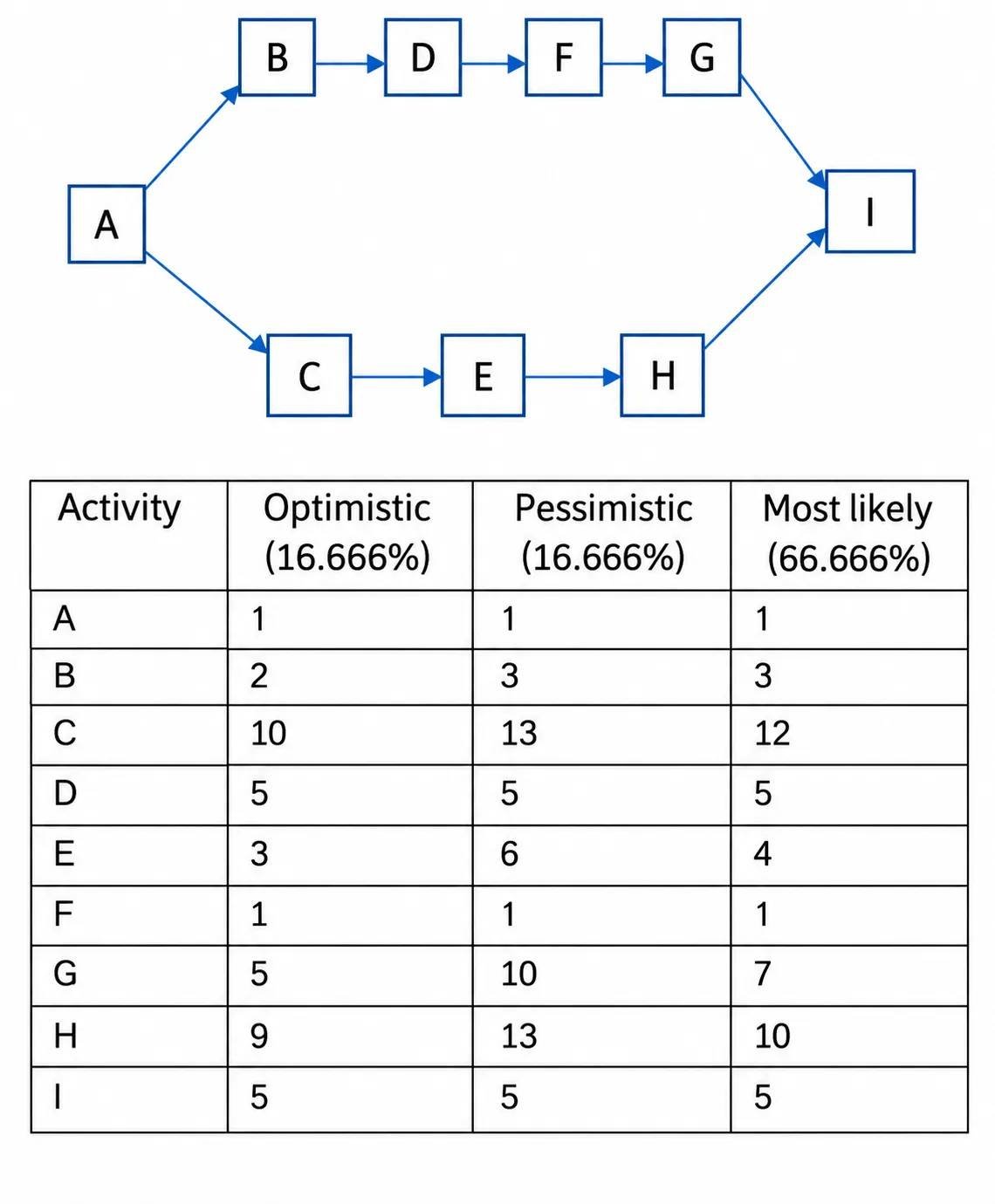
The expected time to prepare the dish is the weighted average of optimistic, pessimistic and most likely time.
Which of the following is the expected wait time for the chef to communicate to the customers?
Solution:
B. Approx. 32.3
Go through the following scenario and answer the questions that follow.
To prepare a dish (e.g., Dosa- Sambhar, Idli-chutney, Rajma-Chawal, Mawa-Bati), the chef has to finish nine activities, some of which could be done simultaneously, while others could not be done simultaneously (see diagram). One of the challenges faced by the chef was to precisely calculate the preparation time of a dish and communicate the waiting time to the customers.
However, based on the past data, the chef had an idea about approximate time taken to complete each activity. He had noted down the best (optimistic), worst (pessimistic) and most likely (most commonly observed) time to finish each of the nine activities. Further, the chef realised that frequency of occurrence of most likely time was 66.666%, and the frequency of occurrence of pessimistic and optimistic times were 16.666% each. The diagram below shows the activities involved and the table shows the optimistic, pessimistic, and most likely times for each activity. Time is indicated in minutes in the table below.
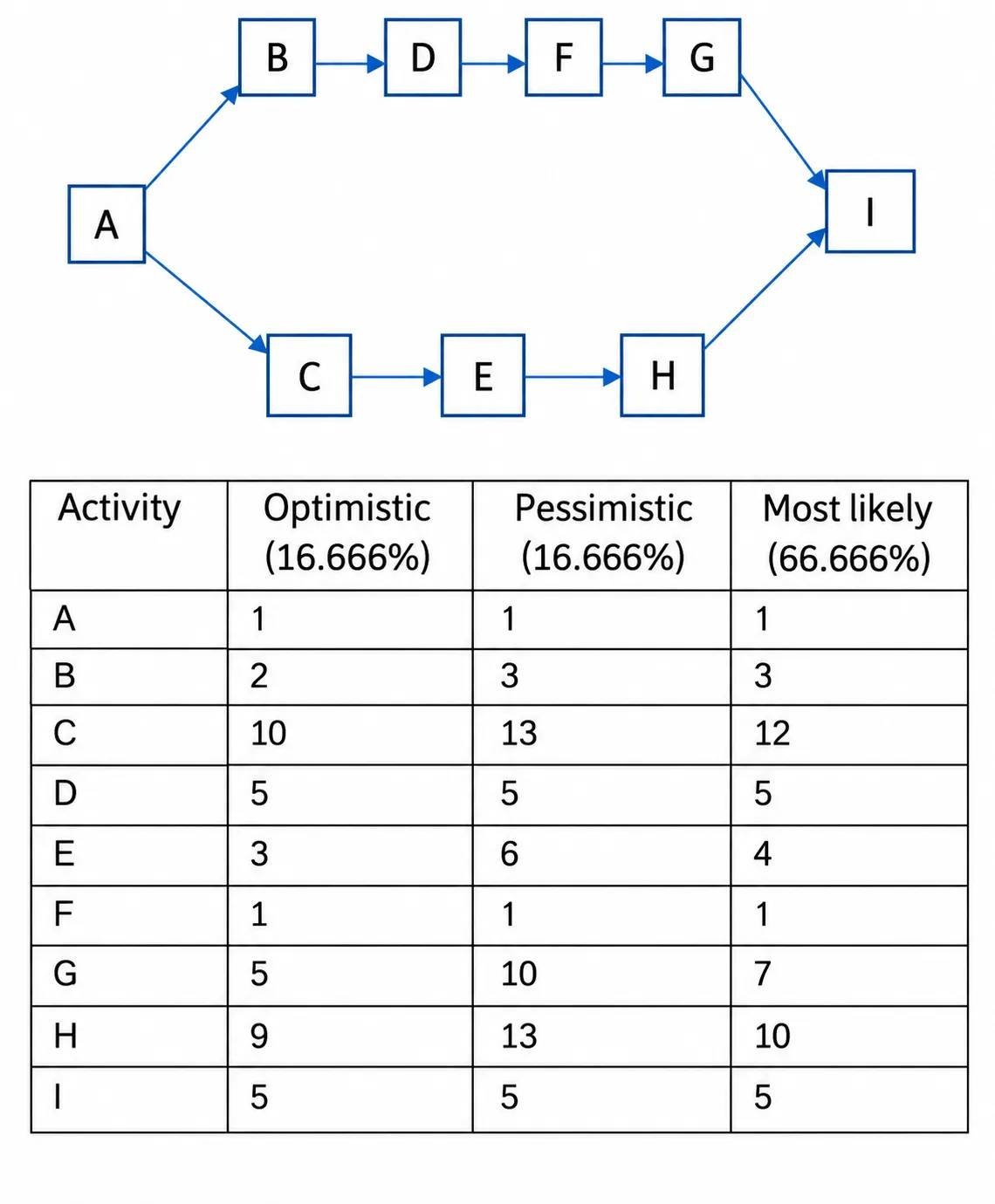
Customer dissatisfaction is the difference of actual waiting time (AWT) and expected waiting time (EWT). AWT is the actual time spent by customer before being served the dish. EWT of the customer is the time communicated by the chef.
What is the minimum waiting time (EWT) that the chef should communicate to minimise customer dissatisfaction?
Solution:
B. 38
Go through the following scenario and answer the questions that follow.
To prepare a dish (e.g., Dosa- Sambhar, Idli-chutney, Rajma-Chawal, Mawa-Bati), the chef has to finish nine activities, some of which could be done simultaneously, while others could not be done simultaneously (see diagram). One of the challenges faced by the chef was to precisely calculate the preparation time of a dish and communicate the waiting time to the customers.
However, based on the past data, the chef had an idea about approximate time taken to complete each activity. He had noted down the best (optimistic), worst (pessimistic) and most likely (most commonly observed) time to finish each of the nine activities. Further, the chef realised that frequency of occurrence of most likely time was 66.666%, and the frequency of occurrence of pessimistic and optimistic times were 16.666% each. The diagram below shows the activities involved and the table shows the optimistic, pessimistic, and most likely times for each activity. Time is indicated in minutes in the table below.
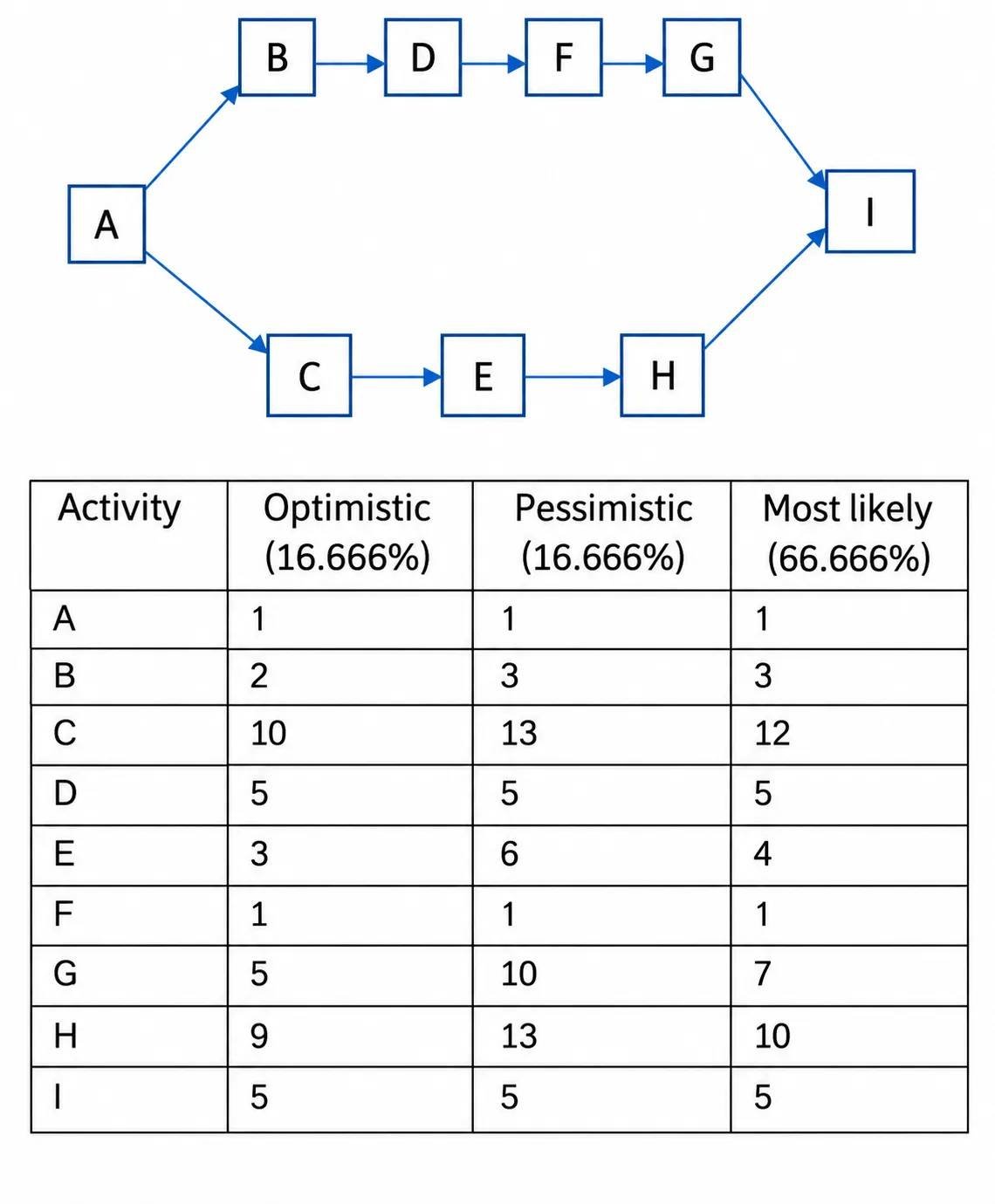
Which of the following is the MOST volatile activity for the chef?
Solution:
C. G
Read the following scenario and answer the questions that follow.
The CEO of the Jamshedpur Tea Factory (JTF) was in a quandary over employees skipping work. It was becoming increasingly difficult for him to identify employees who faked illness to skip work. The work of the employees was complex and intricate, and they had to report to eight supervisors. “Faking illness” made it difficult for JTF to judiciously decide on “Promotion” and “Training” of employees. An employee could only be promoted on the completion of a multi-skilling training program. Further, to be nominated for the training program, an employee must be recommended by a minimum of six supervisors. JTF wanted to promote only sincere and deserving employees.
The CEO was thinking of changing the policy regarding leave, training & promotion.
Which of the following will be the MOST efficient course of action for JTF and yet be fair to the employees?
Solution:
D. Let the CEO office decide on leave but supervisors will recommend promotions.