
XAT 2022 QADI
Q1–10 of 28Sheela purchases two varieties of apples - A and B - for a total of Rupees 2800. The weights in kg of A and B purchased by Sheela are in the ratio 5 : 8 but the cost per kg of A is 20% more than that of B. Sheela sells A and B with profits of 15% and 10% respectively.
What is the overall profit in Rupees?
A supplier receives orders from 5 different buyers. Each buyer places their order only on a Monday. The first buyer places the order after every 2 weeks, the second buyer, after every 6 weeks, the third buyer, after every 8 weeks, the fourth buyer, every 4 weeks, and the fifth buyer, after every 3 weeks. It is known that on January 1st, which was a Monday, each of these five buyers placed an order with the supplier.
On how many occasions, in the same year, will these buyers place their orders together excluding the order placed on January 1st?
The sum of the cubes of two numbers is 128, while the sum of the reciprocals of their cubes is 2.
What is the product of the squares of the numbers?
Let us suppose that the two numbers are ‘\(a\)’ and ‘\(b\)’
Given that \(a^3 + b^3 = 128\)
\( \frac{1}{a^3} + \frac{1}{b^3} = 2 \)
\( \frac{a^3+b^3}{a^3b^3} = 2 \)
\( a^3b^3 = 64 \)
\( (ab)^3 = 64 \)
\( ab = 4 \)
\( (ab)^2 = a^2b^2 = 16 \)
Therefore, the correct answer is \(16\).
Some members of a social service organization in Kolkata decide to prepare 2400 laddoos to gift to children in various orphanages and slums in the city, during Durga Puja. The plan is that each of them makes the same number of laddoos. However, on laddoo-making day, ten members are absent, thus each remaining member makes 12 laddoos more than earlier decided.
How many members actually make the laddoos?
Ramesh and Reena are playing with triangle ABC. Ramesh draws a line that bisects ∠BAC; this line cuts BC at D. Reena then extends AD to a point P. In response, Ramesh joins B and P. Reena then announces that BD bisects ∠PBA, what a surprise! Together, Ramesh and Reena find that BD= 6 cm, AC= 9 cm, DC= 5 cm, BP= 8 cm, and DP = 5 cm.
How long is AP?
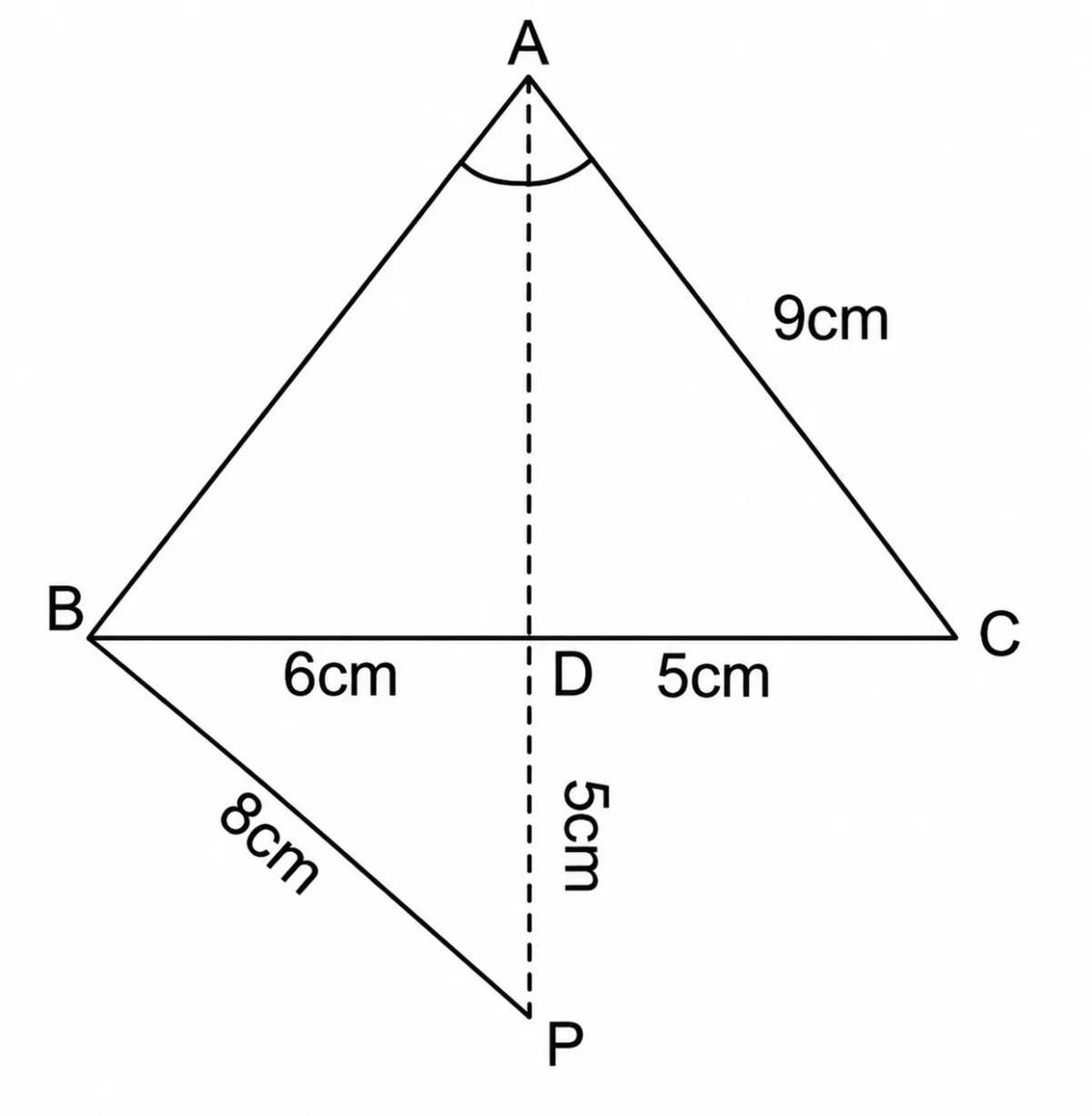
It is given that AD bisects the \(\angle BAC\)
By angle bisector theorem, \(\frac{AB}{AC} = \frac{BD}{DC}\)
Hence \(AB = \frac{6}{5} \times 9 = 10.8\)
Now Reena annouces that BD bisects \(\angle ABP\)
Again by angle bisector theorem, \(\frac{BP}{AB} = \frac{PD}{AD}\)
\( AD = \frac{10.8}{8} \times 5 = 6.75 \)
Therefore, the length of AP = \(AD + DP = 6.75 + 5 = 11.75\text{cm}\)
A marble is dropped from a height of 3 metres onto the ground. After the hitting the ground, it bounces and reaches 80% of the height from which it was dropped. This repeats multiple times. Each time it bounces, the marble reaches 80% of the height previously reached. Eventually, the marble comes to rest on the ground.
What is the maximum distance that the marble travels from the time it was dropped until it comes to rest?
Given that a marble is dropped from a height of 3 meters and every time it reaches up to 80% of height from where it is dropped.
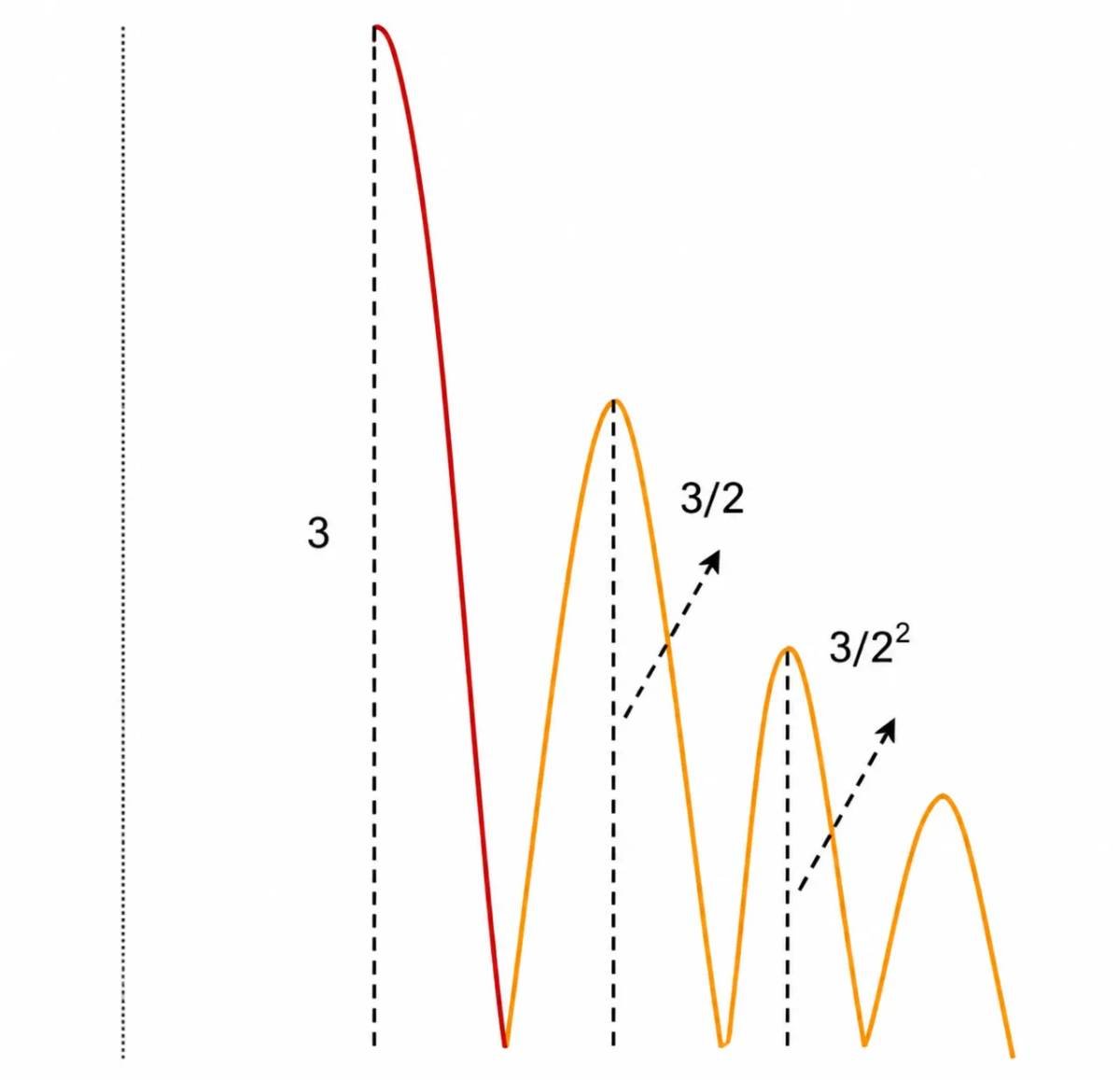
For the first part of the motion it falls from a height of \(3m\) and from here on everytime it bounces to a certain height it falls the same length and thus the distances appear twice in the summation
So the series is
\( 3 + 3(0.8) + 3(0.8) + 3(0.8)^2 + 3(0.8)^2 + 3(0.8)^3 + 3(0.8)^3 + \ldots\ldots\ldots\ldots \)
\( 3 + 2[3(0.8) + 3(0.8)^2 + 3(0.8)^3 + \ldots\ldots] \)
\( = 3 + 2\left[\frac{3(0.8)}{1-0.8}\right] \quad \{S_n = \frac{a}{1-r}\} \)
\( = 3 + 24 \)
\( = 27 \)
Therefore, the answer should be \(27m\).
Fatima found that the profit earned by the Bala dosa stall today is a three-digit number. She also noticed that the middle digit is half of the leftmost digit, while the rightmost digit is three times the middle digit. She then randomly interchanged the digits and obtained a different number. This number was more than the original number by 198.
What was the middle digit of the profit amount?
Kim's wristwatch always shows the correct time, including 'am' and 'pm'. Jim's watch is identical to Kim's watch in all aspects except its pace, which is slower than the pace of Kim's watch. At 12 noon on January 1st, Jim sets his watch to the correct time, but an hour later, it shows 12:57 pm. At 12 noon on the next June 1st, Jim resets his watch to the correct time.
On how many instances between, and including 12 noon on the two dates mentioned, do Jim's and Kim's watches show the exact same time, including the 'am' and the 'pm'?
At 12 noon on January 1st, Jim sets his watch to the correct time, but an hour later, it shows 12:57 pm.
So, Jim’s watch loses 3 mins for 1 hour.
To show the correct time again Jim’s watch should lose 24hrs.
To loose 24hrs, it needs \(480\)hrs (means 20days)
For every 20 days, both watches show the same time.
From Jan01st to june01st(noon) we have 151 days.
The both watches should show correct time in \(\frac{151}{20}\) times.
Jim's and Kim's watches show the exact same time including 12 noon on the two dates mentioned is \(7 + 2 = 9\) times
Nadeem's age is a two-digit number X, squaring which yields a three-digit number, whose last digit is Y. Consider the statements below:
Statement I: Y is a prime number
Statement II: Y is one-third of X
To determine Nadeem's age uniquely:
Nadeem's age is a two-digit number \(X\), squaring which yields a three-digit number, whose last digit is \(Y\).
Let us take the statement I:
The possible numbers which satisfying statement (I) is \(225(15^2)\) and \(625(25^2)\)
So we have two possible outcomes. Hence statement (I) alone is not sufficient
Now let us take statement II:
The possible numbers which satisfy statement (II) are
\( 144(12^2),\quad 225(15^2),\quad 729(27^2) \)
So we have three possible outcomes. Hence statement (II) alone is not sufficient.
But by using I & II we can get only one solution which is \(15\).
Therefore, both statements I & II are required to answer the question.
Wilma, Xavier, Yaska and Zakir are four young friends, who have a passion for integers. One day, each of them selects one integer and writes it on a wall. The writing on the wall shows that Xavier and Zakir picked positive integers, Yaska picked a negative one, while Wilma's integer is either negative, zero or positive. If their integers are denoted by the first letters of their respective names, the following is true:
\( W^4 + X^3 + Y^2 + Z \leq 4 \)
\( X^3 + Z \geq 2 \)
\( W^4 + Y^2 \leq 2 \)
\( Y^2 + Z \geq 3 \)
Given the above, which of these can \( W^2 + X^2 + Y^2 + Z^2 \) possibly evaluate to?
\( W^4 + X^3 + Y^2 + Z \leq 4 \)
\( X^3 + Z \geq 2 \)
\( W^4 + Y^2 \leq 2 \)
\( Y^2 + Z \geq 3 \)
\( W^4 + X^3 + Y^2 + Z \leq 4 \)
We can isolate the terms as \(W^4 + Y^2 + X^3 + Z \leq 4\)
From here we can see that the equalities [2] and [3] together make up [1]
From inequation [2],
\( Z \text{ can be } 1 \text{ or } 2 \text{ and } X \text{ can be } 0 \text{ or } 1 \)