
AREA PROBLEMS(TRIANGLES & SQUARE)
Q1–10 of 85The base of a triangle is 15 cm and height is 12 cm. The height of another triangle of double the area having the base 20 cm is
Area = ½ × base × height. Find area of first triangle, double it, then solve for height using the new base 20 cm.
The area of a right-angled triangle is 40 times its base. What is its height?
Set up Area = ½ × base × height = 40 × base. The base cancels, giving height directly.
The area of a triangle is p sq. cm and its base is x cm. What is the height of the triangle (in cm)?
Area = ½ × base × height → p = ½ × x × h. Solve for h.
The ratio of the areas of a square of side 6 cm and an equilateral triangle of side 6 cm is
Square area = side². Equilateral triangle area = (√3/4) × side². Same side length — form the ratio and simplify.
ABCD is a rectangle and ABE is a triangle whose vertex E lies on CD. If AB = 5 cm and the area of the triangle is 10 sq. cm, then the perimeter of the rectangle is
Triangle ABE has base AB = 5 cm (a side of the rectangle) and its height equals the rectangle's other side (since E lies on CD, the opposite side). Use area = ½ × base × height to find that side, then compute perimeter.
In ΔPQR (right-angled at Q), side PQ = 32 cm and side PR = 25 cm. What is the measure of side QR?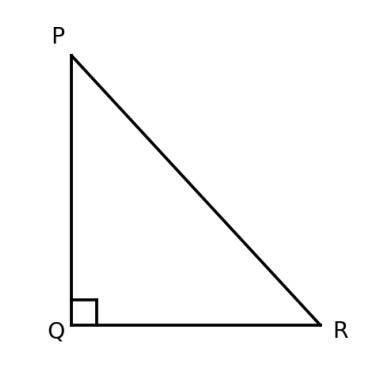
Right angle at Q means PQ and QR are the legs, PR is the hypotenuse. Use Pythagoras: QR² = PR² − PQ².
Consider the given figure (rectangle ABCD with L the midpoint of AB and M the midpoint of DC; diagonals AC, DB, AM and DL are drawn intersecting at X). If the areas of the triangles LDC, BMC and AMC are denoted by x, y and z respectively, then
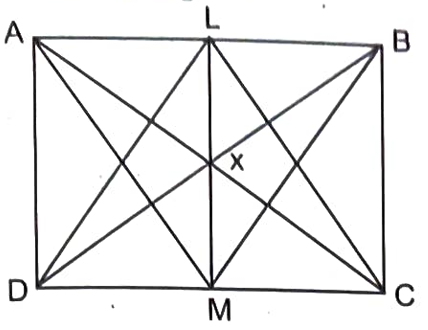
Since L and M are midpoints, triangles LDC and BMC each have half the base of the full side, so their areas relate simply to the whole rectangle's area; triangle AMC (with full base DC) has area equal to y. Compare base/height ratios directly rather than computing absolute areas.
If three sides of a triangle are 6 cm, 8 cm and 10 cm, then the altitude of the triangle, using the largest side as its base, will be
First check 6-8-10 is a right triangle (it is, since 6²+8²=10²). Area = ½ × 6 × 8. Then use area = ½ × 10 × altitude to solve for altitude.
The sides of a triangle are 3 cm, 4 cm and 5 cm. The area (in cm²) of the triangle formed by joining the mid-points of the sides of this triangle is
The midpoint triangle is similar to the original with ratio 1:2, so its area is ¼ of the original. Find area of 3-4-5 triangle first (right triangle, ½×3×4).
The sides of a triangle are 5 cm, 6 cm, and 7 cm. One more triangle is formed by joining the mid-points of the sides. The perimeter of the second triangle in cm is
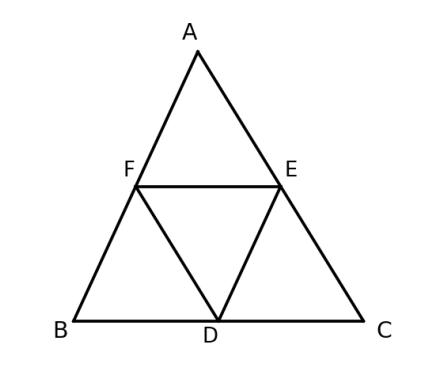
The midpoint triangle's sides are half the original's sides, so its perimeter is half the original triangle's perimeter.