
Practice Exercise on Geometry and Mensuration
Q1–10 of 55In the figure given, what is the measure of ∠ACD?

Use the exterior angle property of a triangle (exterior angle = sum of the two remote interior angles), or the angle-sum property, based on the angles marked in the figure.
Two circles C₁ and C₂ of radius 2 and 3 respectively touch each other as shown in the figure. If AD and BD are tangents then the length of BD is

Drop a perpendicular from the smaller circle's centre to the radius line of the larger circle to form a right triangle; use the difference of radii (3−2) and the distance between centres (3+2) with the Pythagorean theorem.
If the sides of a triangle measure 13, 14, 15 cm respectively, what is the height of the triangle for the base side 14?
Use Heron's formula to find the area of the 13-14-15 triangle, then use Area = ½ × base × height with base 14.
A right angled triangle is drawn on a plane such that sides adjacent to the right angle are 3 cm and 4 cm. Now three semi-circles are drawn taking all three sides of the triangle as diameters respectively (as shown in the figure). What is the area of the shaded regions A₁ + A₂?
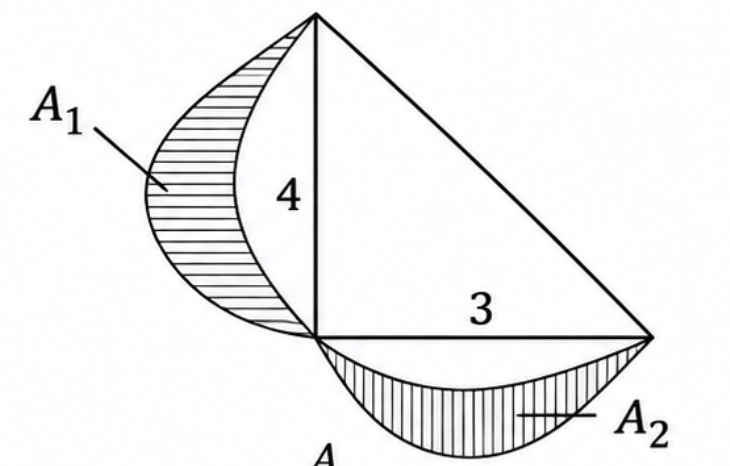
Recognize this as the classic "lune" result: for a right triangle, the sum of the two smaller lune areas equals the area of the triangle itself.
A lateral side of an isosceles triangle is 15 cm and the altitude is 8 cm. What is the radius of the circumscribed circle?
Use the altitude to split the isosceles triangle into two right triangles to find the base, then apply R = (product of sides)/(4 × Area).
Let a, b, c be the lengths of the sides of triangle ABC. Given (a + b + c)(b + c − a) = αbc. Then the value of α will lie in between
Use the triangle inequality (b + c − a > 0 and a + b + c is always positive but bounded) to determine the range of α; test with a degenerate/equilateral case for bounds.
In the figure given below (not drawn to scale), A, B and C are three points on a circle with centre O. The chord BC is extended to point T such that AT becomes a tangent to the circle at point A. If ∠CTA = 35° and ∠CAT = 45°, calculate x° (∠BOC).

Use the tangent-chord angle (∠between tangent and chord = angle in alternate segment) along with the exterior angle of triangle ACT to find ∠ABC, then use the central angle = 2 × inscribed angle relation.
In the given figure, AB = 20, BC = 15, CA = 19. Calculate a, b, c.
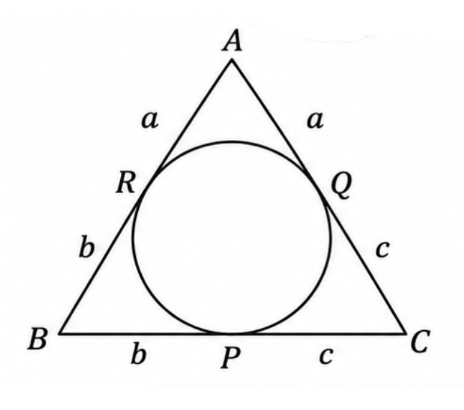
This is about the incircle/excircle tangent lengths — use the standard tangent-length formulas: distances from vertices to points of tangency equal s−a, s−b, s−c where s is the semi-perimeter.
In the given figure, AB = 20, BC = 15, CA = 19. Calculate a, b, c.

Use the fact that AB⊥ED to set up a right angle, then use angle-sum in the small triangles formed with the given 75° and 30° to trace through to ∠ABC.
The angle between lines L and M measures 35°. If line M is rotated 45° counter-clockwise about point P to line M¹, what is the angle in degrees between lines L and M¹?

Add or subtract the rotation angle (45°) from the original angle (35°) depending on direction; consider both configurations to see which fits the answer choices.