
ARITHMETIC PROBLEMS (CAT PYQs) PART-2
Q1–10 of 50Directions for Questions : Answer the following questions based on the information given below: Cities A and B are in different time zones. A is located 3000 km east of B. The table below describes the schedule of an airline operating non-stop flights between A and B. All the times indicated are local and on the same day
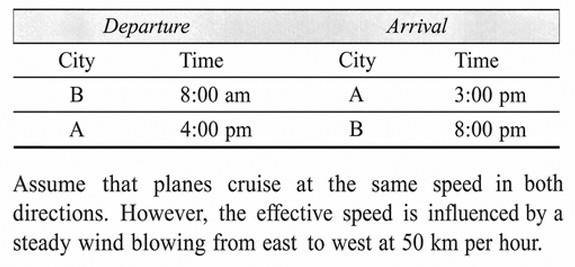
What is the plane's cruising speed in km per hour?
Experience tells us that most students got stuck in this problem because they got stuck in equation creation and the infeasible thought processes. The correct thought process would give you the solution to this question in less than 45 seconds after reading the question fully. For this process, you need to get the following reactions:
Deduction 1: Since the plane flies at 8 am from City B and lands back at 8 pm the same day, the round trip takes 12 hours, out of which 1 hour is spent at City A (where it lands at 3 pm local time and takes off at 4 pm local time). Hence, the total flying time is 11 hours.
Deduction 2: Go into the options for Q1. Since the distance is 3000 and the speed of the wind is 50 kmph, options (a), (c) and (d) cannot give you an answer. WHY?? Simply because for option (a) to work we would need 3000/650 + 3000/750 to be equal to 11 hours. Leave alone 11, this will not even give us an integral answer hence we do not need to check this option. Similarly options (d) and (c) will not work as they would not give integral values for the above expression. Checking option (b), we get 3000/500 + 3000/600 = 11 hours. Hence, the cruising speed of the plane would be 550.
Deduction 3: Since we are now equipped with the answer to Q1 (below), we can easily go back to the earlier question and realise that the plane would take six hours to reach City A from City B. Thus, the time difference would be 1 hour (option d).
Directions for Questions : Answer the following questions based on the information given below: Mr. David manufactures and sells a single product at a fixed price in a niche market. The selling price of each unit is ₹30. On the other hand the cost, in rupees, of producing 'x' units is 240 + bx + cx², where 'b' and 'c' are some constants. Mr. David noticed that doubling the daily production from 20 to 40 units increases the daily production cost by 66.66%. However, an increase in daily production from 40 to 60 units results in an increase of only 50% in the daily production cost. Assume that demand is unlimited and that Mr. David can sell as much as he can produce. His objective is to maximize the profit.
How many units should Mr. David produce daily?
According to the question when we increase the production from 20 to 40 then daily production cost increases by 66.66%. It means
[(240 + 40b + 402c) − (240 + 20b + 202c)] ⁄ [240 + 20b + 202c] = 2/3 (1)
It is also given that when we increase the production from 40 to 60 then daily production cost increases by 50%.
[(240 + 60b + 602c) − (240 + 40b + 402c)] ⁄ [240 + 40b + 402c] = 1/2 (2)
By solving equation 1 and equation 2 we get c = 1/10 and b = 10
Cost for production of x units = 240 + 10x + x2/10
Profit earned from x units = (30x − 240 − 10x − x2/10)
= 760 − (1/10)(x − 100)2
To maximize the profit, x − 100 should be equal to 0.
⇒ x = 100
Directions for Questions: Answer the following questions based on the information given below: Mr. David manufactures and sells a single product at a fixed price in a niche market. The selling price of each unit is ₹30. On the other hand the cost, in rupees, of producing 'x' units is 240 + bx + cx², where 'b' and 'c' are some constants. Mr. David noticed that doubling the daily production from 20 to 40 units increases the daily production cost by 66.66%. However, an increase in daily production from 40 to 60 units results in an increase of only 50% in the daily production cost. Assume that demand is unlimited and that Mr. David can sell as much as he can produce. His objective is to maximize the profit.
What is the maximum daily profit, in rupees, that Mr. David can realize from his business?
Maximum profit = 760. Option (d)
A shop stores x kg of rice. The first customer buys half this amount plus half a kg of rice. The second customer buys half the remaining amount plus half a kg of rice. Then the third customer also buys half the remaining amount plus half a kg of rice. Thereafter, no rice is left in the shop. Which of the following best describes the value of x?
The value of x must be odd because only with an odd value of x would you keep getting integers if you halved the value of rice and took out the another half of 1 kg from the shop store.
Now let's start checking the options:
Option (b): x = 7 kg
7 → 3 → 1 → 0
It means x = 7 kg satisfies the given conditions. So this option is correct.
Similarly, we can check the other options as well and see only option (b) is correct.
In a survey of political preferences, 78 per cent of those asked, were in favour of at least one of the proposals I, II and III. 50 per cent of those asked favoured proposal I, 30 per cent favoured proposal II and 20 per cent favoured proposal III. If 5 per cent of those asked favoured all the three proposals, what percentage of those asked favoured more than one?
We can use the principle of set theory here directly.
78 = 50% + 30% + 20% − (I ∩ II) − (I ∩ III) − (II ∩ III) + 5% = 27%
Hence, the percentage of those who favored more than one of the three proposals was 32 per cent (option (c)).
A student took five papers in an examination, where the full marks were the same for each paper. His marks in these papers were in the proportion of 6:7:8:9:10. In all papers together, the candidate obtained 60 per cent of the total marks. Then the number of papers in which he got more than 50 per cent marks is:
Since his marks are in the ratio 6:7:8:9:10, we can assume the values of the numbers to be 6x, 7x, 8x, 9x and 10x. The average would be 8x and since the average is 60%, x = 7.5%. Hence, he would get over 50 per cent marks in four subjects.
Every 10 years the Indian government counts all the people living in the country. Suppose that the director of the census has reported the following data on two neighbouring villages—ChotaHazri and MotaHazri. ChotaHazri has 4,522 fewer males than MotaHazri. MotaHazri has 4,020 more females than males. ChotaHazri has twice as many females as males. ChotaHazri has 2,910 fewer females than MotaHazri. What is the total number of males in ChotaHazri?
The following table can be constructed for solving this question:
| Town | Males | Females |
|---|---|---|
| ChotaHazri | x | 2x |
| MotaHazri | x + 4522 | x + 4522 + 4020 = x + 8542 |
We also know that x + 8542 − 2x = 2910. Solving for x, we get x = 5632. Hence, option (c) is correct
Shyama and Vyom walk up an escalator (moving stairway). The escalator moves at a constant speed. Shyama takes three steps for every two of Vyom's steps. Shyama gets to the top of the escalator after having taken 25 steps, while Vyom (because her slower pace lets the escalator do a little more of the work) takes only 20 steps to reach the top. If the escalator were turned off, how many steps would they have to take to walk up?
This question has to be seen from the perspective of the work done by the escalator. Since the ratio of speeds of walking of Shyama and Vyom is 3:2, when Shyama take 25 steps, Vyom would take 16.66 steps. Let us say that the escalator would do x steps of work in this time. The value of x would be such that 25 + x would be equal to the total number of steps. We also know that when Vyom walks up the escalator he does 20 steps. Hence, in the time Vyom does 20 steps, the escalator should do 1.2x steps. So 20 + 1.2x should also give us the same value for the total number of steps. This means that the work done by the escalator should be 20 per cent higher when Vyom reaches the top than the work that was done when Shyama reached the top. From this point you can go in two ways:
(i) By equating 25 + x = 20 + 1.2x → x = 25. Hence, the escalator has 50 steps.
(ii) By going through options, we can easily see that if the escalator had 50 steps, then there would be a coverage of 25 steps for Shyama and 30 for Vyom which represents the required increase of 20 per cent.
A can complete a piece of work in 4 days. B takes double the time taken by A. C takes double that of B, and D takes double that of C to complete the same task. They are paired in groups of two each. One pair takes two-thirds the time needed by the second pair to complete the work. Which is the first pair?
A's work is 25 per cent, B's work is 12.5 per cent, C's work is 6.25 per cent and D's work is 3.125 per cent. It is evident that if we take A and D together, they would take two-thirds the time of the other pair since the work ratio would be 3:2.
A lot of work remains while preparing a birthday dinner. Even after the turkey is in the oven, there are still the potatoes and gravy, yams, salad, and cranberries, not to mention setting the table. Three friends, Asit, Arnold and Afzal work together to get all of these chores done. The time it takes them to do the work together is six hours less than Asit would have taken working alone, one hour less than Arnold would have taken alone, and half the time Afzal would have taken working alone. How long did it take them to do these chores working together?
Solving through options, the most convenient option to check is option (c). Since we are going to do percentage calculations— the vision you need to see this comes from the first information itself, which says that Asit takes 6 hours more than all the three take working together. If you were to take 40 minutes as the value, Asit would be 400 giving convenient percentage values of the work done by each person. You should realise that no other value gives as convenient values as this—hence at least this should be the first option to check for. Testing this option we get—Work done by all three per minute = 2.5% of the work.
Time taken by Asit = 400 minutes. Hence, work done per minute = 0.25%
Time taken by Arnold = 100 minutes.
Hence, work done per minute = 1%
Time taken by Afzal = 80 minutes. Hence, work done per minute = 1.25%
We can see that 2.5 = 0.25 + 1 + 1.25. Hence, this is the correct option.
It is a moot point that the first option we tried itself worked!! Were we lucky?? Not really. Try changing the other incorrect options forcefully and putting in whatever option you might want to insert. Can you create an option within a reasonable range of values where all the three times for Asit, Arnold and Afzal would be a convenient number so that the percentage values fit in?? Chances are you might not be able to find another single value which creates such 'convenient' decimals!!