
Algebra Review Test 2
Q1–10 of 20The number of solutions of
\( \dfrac{\log 5+\log(y^2+1)}{\log(y-2)}=2 \) is
Domain constraints:
For $\log(y - 2)$ to be defined, $y - 2 > 0 \implies y > 2$.
The denominator cannot be zero: $\log(y - 2) \neq 0 \implies y - 2 \neq 1 \implies y \neq 3$.
Thus, domain requires $y > 2$ and $y \neq 3$.
Solving the equation:
$$\log 5 + \log(y^2 + 1) = 2 \log(y - 2)$$$$\log [5(y^2 + 1)] = \log(y - 2)^2$$$$5y^2 + 5 = (y - 2)^2$$$$5y^2 + 5 = y^2 - 4y + 4$$$$4y^2 + 4y + 1 = 0 \implies (2y + 1)^2 = 0 \implies y = -\frac{1}{2}$$Check domain:
$y = -\frac{1}{2}$ violates $y > 2$. Therefore, there are no valid solutions.
Answer: (d) None of these (0 solutions)
Information for Questions 2 and 3: Given below are two graphs labeled F(x) and G(x). Compare the graphs and give the answer in accordance to the options given below:
Q.
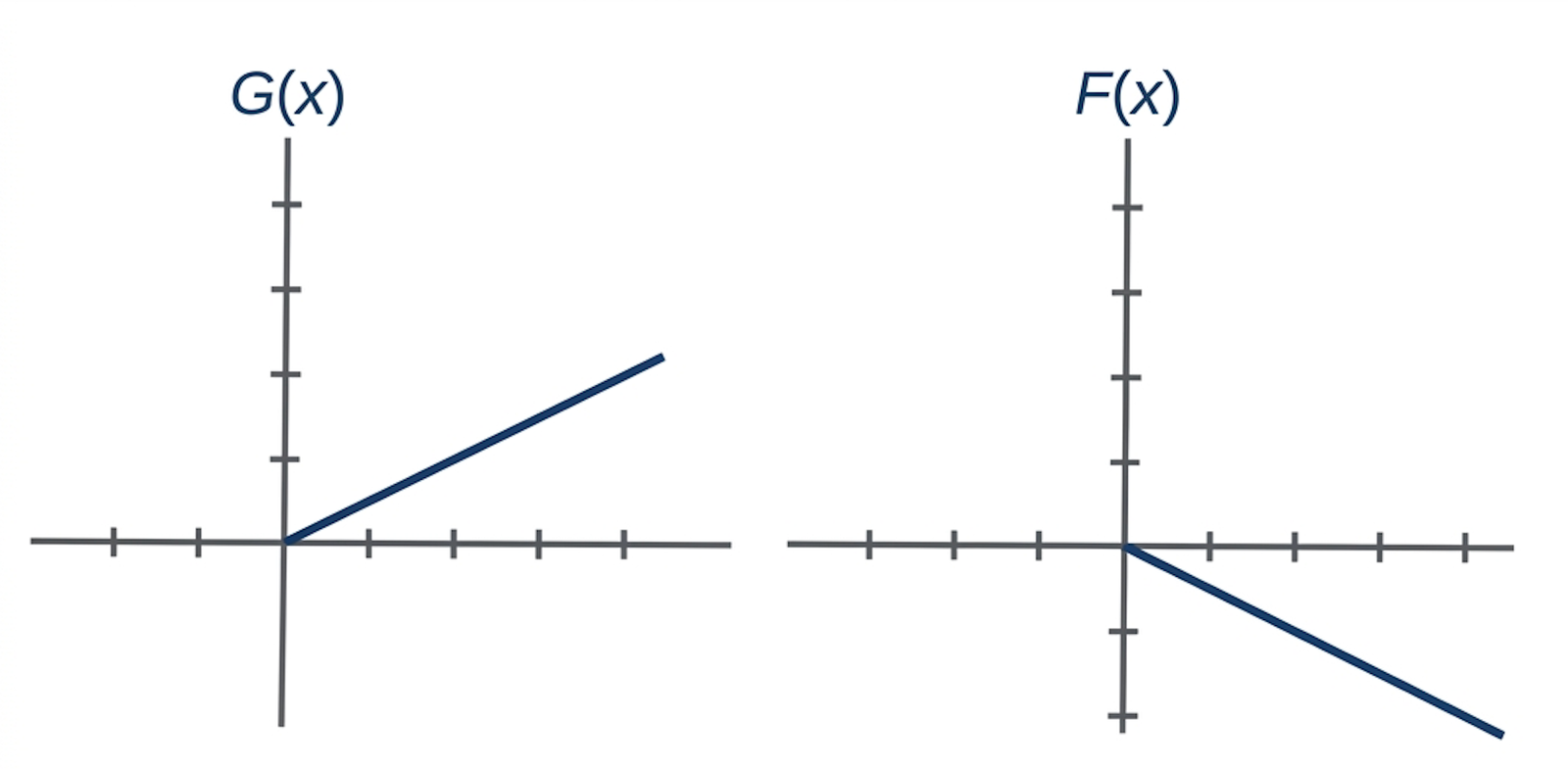
Analyze $G(x)$:
It is defined for $x \ge 0$ with positive slope, say $m = \frac{1}{2} \implies G(x) = \frac{x}{2}$ for $x \ge 0$.
Analyze $F(x)$:
It is defined for $x \ge 0$ going downwards with slope $-m \implies F(x) = -\frac{x}{2}$ for $x \ge 0$.
Evaluate $F(-x)$:
$F(-x)$ flips $F(x)$ across the y-axis, making it defined for $x \le 0$.
Notice $G(x)$ is defined for $x \ge 0$.
Taking $-G(x)$ flips $G(x)$ upside down in the 4th quadrant (slope $-1/2$).
$F(-x)$ has slope $+1/2$ for $x \le 0$, which is exactly $-G(-x)$.
Answer: (d) None of these
Information for Questions 2 and 3: Given below are two graphs labeled F(x) and G(x). Compare the graphs and give the answer in accordance to the options given below:
Q.
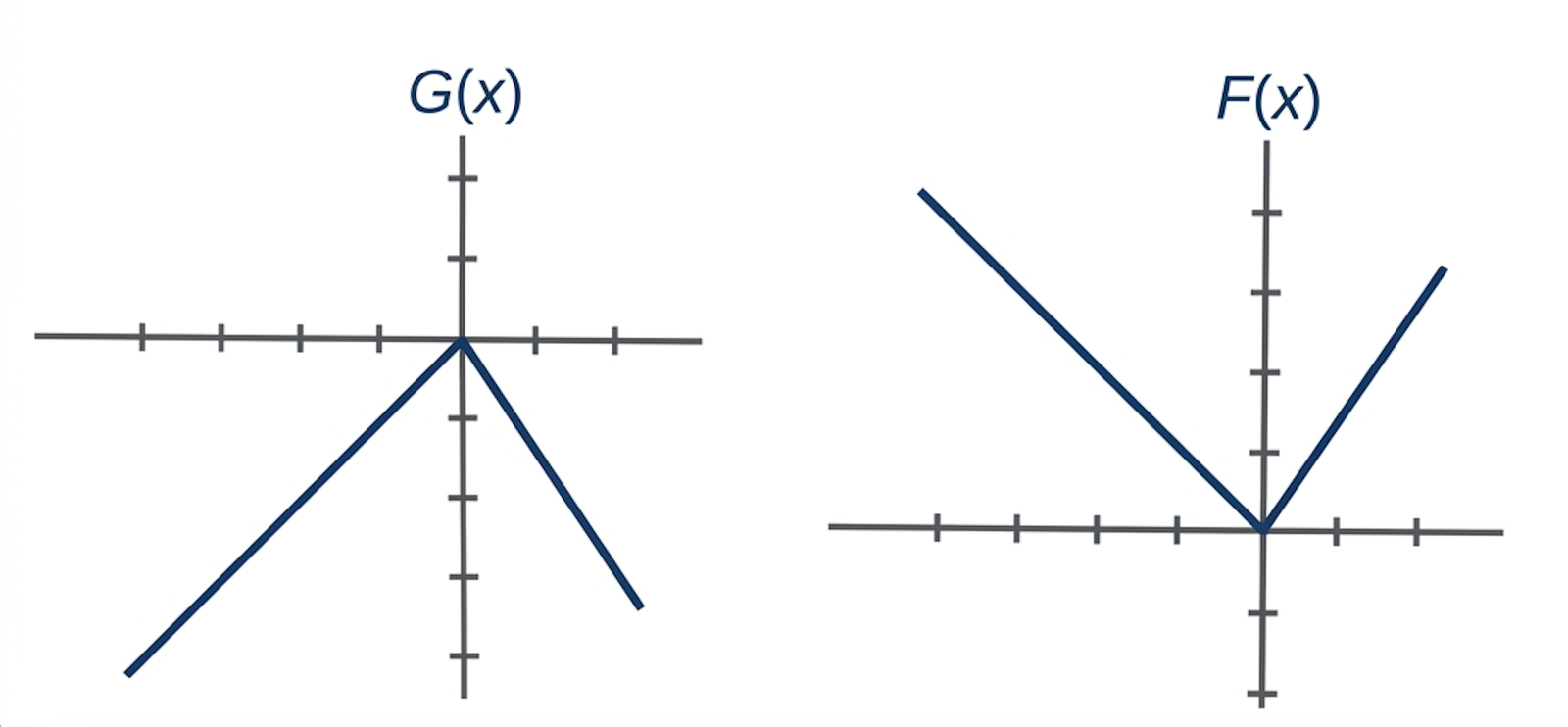
$G(x)$ is a $V$-shape pointing downwards: $G(x) = -\vert{}x\vert{}$.
$F(x)$ is a $V$-shape pointing upwards: $F(x) = \vert{}x\vert{}$.
$F(-x) = \vert{}-x\vert{} = \vert{}x\vert{}$.
$-G(x) = -(-\vert{}x\vert{}) = \vert{}x\vert{}$.
Therefore, $F(-x) = -G(x)$.
Answer: (d) None of these (Since $F(-x) = -G(x)$ has no linear shift term)
If a is a natural number which of the following statements is always true?
Let's test each option for any natural number $a \in \{1, 2, 3, \dots\}$:
(a) $(a + 1)(a^2 + 1)$: If $a = 1 \implies 2 \times 2 = 4$ (even). False.
(b) $9a^2 + 6a + 6$: $6a + 6$ is always even. If $a$ is odd, $9a^2$ is odd, making the sum odd. False.
(c) $a^2 - 2a = a(a - 2)$: If $a = 3 \implies 3(1) = 3$ (odd). False.
(d) $a^2(a^2 + a) + 1 = a^3(a + 1) + 1$: $a(a+1)$ is always the product of two consecutive integers, which is always even. Thus, $a^3(a+1)$ is even, and adding $1$ always gives an odd number.
Answer: (d) $a^2(a^2 + a) + 1$ is odd
In the figure below, equation of the line PQ is
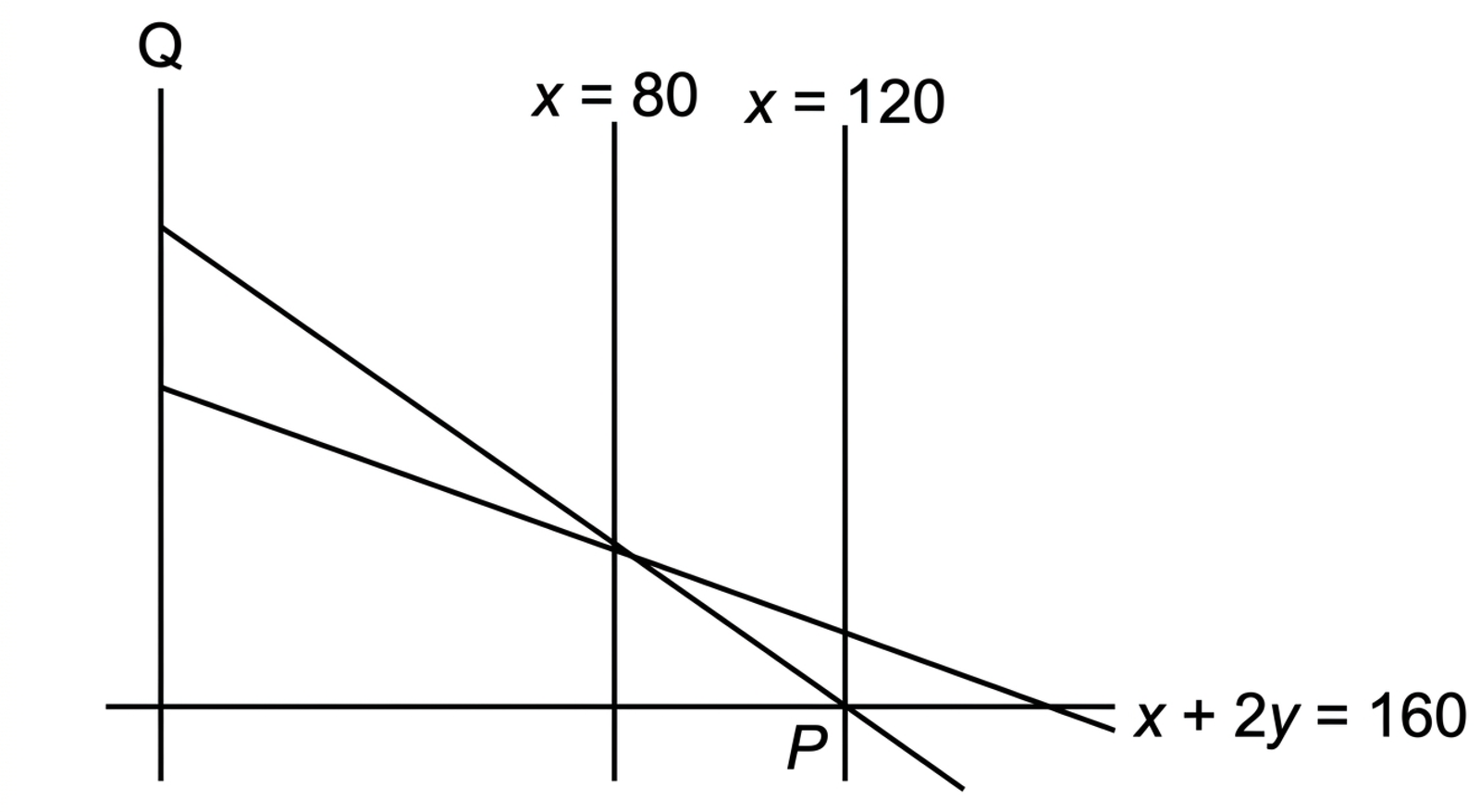
From the figure, point $P$ lies at the intersection of $x = 120$ and $y = 0 \implies \mathbf{P = (120, 0)}$.
$Q$ lies on the y-axis ($x = 0$).
The other given line is $x + 2y = 160$. At $x = 80$, the two lines intersect.
On $x + 2y = 160$, at $x = 80 \implies 80 + 2y = 160 \implies y = 40$.
So line $PQ$ passes through $(80, 40)$ and $P(120, 0)$.
Find the slope of $PQ$:
$$m = \frac{0 - 40}{120 - 80} = \frac{-40}{40} = -1$$Equation of $PQ$:
$$y - 0 = -1(x - 120) \implies x + y = 120$$
Answer: (a) $x + y = 120$
For which of the following functions is
\( \dfrac{f(a)-f(b)}{a-b} \) constant for all the numbers ‘a’ and ‘b’, where a ≠ b?
The ratio $\frac{f(a) - f(b)}{a - b}$ represents the slope of the function.
A constant slope occurs only for a linear function $f(y) = my + c$.
Here, $f(y) = 4y + 7$ has a constant slope of $4$.
Answer: (a) $f(y) = 4y + 7$
Given that \( f(a,b,c)=\dfrac{a+b+c}{3} \), then
(a) \( f(a,b,c)\ge\dfrac{\lvert a\rvert+\lvert b\rvert+\lvert c\rvert}{3} \)
(b) \( f(a,b,c)\ge\max(a,b,c) \)
(c) \( \lvert f(a,b,c)\rvert\ge\dfrac{\lvert a+b+c\rvert}{3} \)
(d) \( \lvert f(a,b,c)\rvert\le\dfrac{\lvert a\rvert+\lvert b\rvert+\lvert c\rvert}{3} \)
By the Triangle Inequality for real numbers:
Taking absolute value of $f(a, b, c)$:
Answer: (d) $\vert{}f(a, b, c)\vert{} \le \frac{\vert{}a\vert{} + \vert{}b\vert{} + \vert{}c\vert{}}{3}$
We are given two variables \( x \) and \( y \). The values of the variables are
\( x=\dfrac{1}{a+b} \) and \( y=\dfrac{3}{c+x} \). Find the value of the expression \( \dfrac{7y}{x} \)
(a) \( \dfrac{21(a+b)^2}{ca+cb+1} \)
(b) \( \dfrac{3(a+b)}{7ab+ac} \)
(c) \( \dfrac{7}{3(ca+cb+1)} \)
(d) None of these
Express $y$ in terms of $a$, $b$, and $c$:
Given $x = \dfrac{1}{a + b}$:
Calculate $\dfrac{7y}{x}$:
Since $\dfrac{1}{x} = a + b$:
If \( p=\dfrac{12-\lvert x-3\rvert}{12+\lvert x-3\rvert} \) the maximum value that ‘p’ can attain is:
Let $k = \vert{}x - 3\vert{}$. Since absolute value is non-negative, $k \ge 0$.
Express $p$:
To maximize $p$, we must minimize $k$:
Minimum value of $k = \vert{}x - 3\vert{}$ is $0$ (at $x = 3$).
Substitute $k = 0$:
Refer to the graph. What does the shaded portion represent?
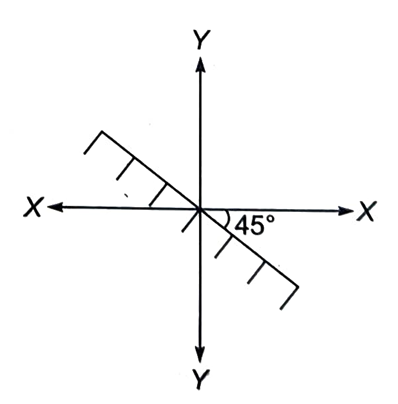
The boundary line passes through the origin at an angle of $45^\circ$ in the 4th quadrant, which corresponds to the line $y = -x \implies x + y = 0$.
Testing a point in the shaded region (e.g., $(1, 1)$ in Quadrant I):
$$1 + 1 = 2 \ge 0$$Therefore, the shaded region represents $x + y \ge 0$.
Answer: (d) $x + y \ge 0$