
Exam Details
SNAP Exam Guide: Pattern, Eligibility, Syllabus & Previous Year Papers
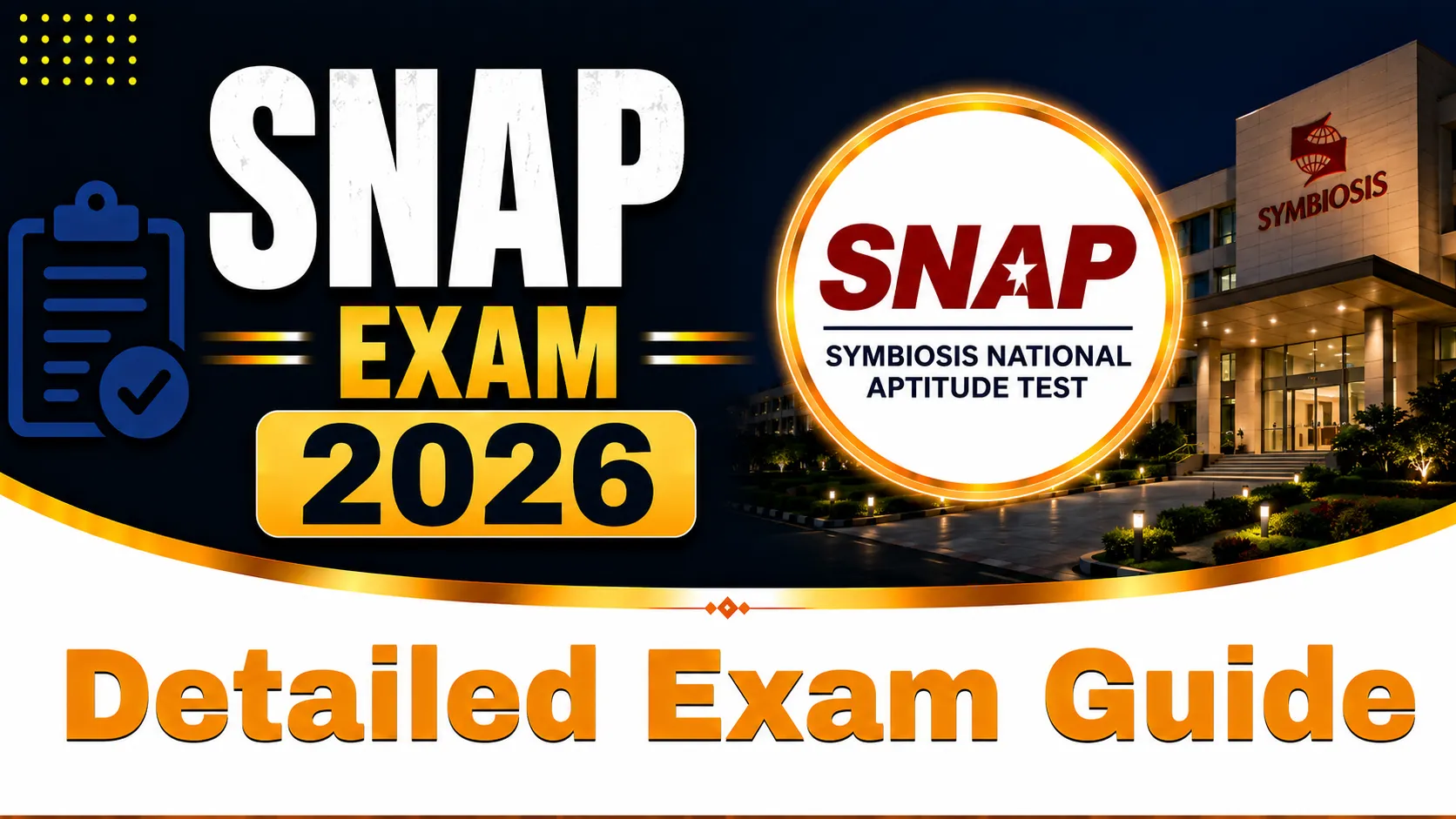
The SNAP Exam (Symbiosis National Aptitude Test) is a national-level MBA entrance examination conducted by Symbiosis International (Deemed University) for admission to MBA / PGDM programmes offered by its constituent institutes - SIBM, SCMHRD, SIMS, SIIB, SIOM etc.
The SNAP exam is conducted once a year. However, candidates are allowed to attempt the exam up to three times in the same admission cycle, and only the highest score is considered for shortlisting. SNAP is usually held between December and January and is known for its short duration, high speed requirement, and accuracy-based evaluation.
Eligibility
SNAP Exam 2026 Educational Qualification & Age Limit
- Bachelor's Degree: Minimum 3-year duration (or equivalent) in any discipline from a recognized university or institution.
- Final Year Candidates: Candidates appearing in the final year of graduation are eligible, provided they complete all requirements by the deadline specified by Symbiosis International (Deemed University).
What Is the Minimum Percentage Required for SNAP 2026?
- SNAP Exam: Minimum 50% aggregate marks in graduation is required to appear for SNAP (45% for SC/ST candidates).
- Participating Institutes: Some specialised programmes — including Business Analytics, Infrastructure Development & Management, and dual degrees — carry additional eligibility criteria beyond this base requirement.
Age Limit for SNAP Exam 2026
- No age limit - Like most management entrance exams, there is no age limit for candidates appearing for SNAP 2026.
Exam Pattern
SNAP 2026 Exam Pattern
The SNAP exam is a 60-minute examination comprising multiple-choice questions designed to test basic aptitude, speed, and accuracy. The SNAP 2026 exam pattern has been revised — a new fourth section, Ethics, Morality and Values, has been introduced this year, with question weightage in General English and Analytical & Logical Reasoning adjusted to accommodate it.
Marking Scheme for SNAP Exam 2026
Correct Answer | +1 mark |
Incorrect Answer | –0.25 mark |
Unattempted Question | No penalty |
SNAP 2026 Section-Wise Number of Questions (Revised)
Section | Number of Questions |
General English | 10 |
Analytical & Logical Reasoning | 20 |
Quantitative, Data Interpretation & Data Sufficiency | 20 |
Ethics, Morality and Values (New) | 10 |
Total | 60 |
This is the first major revision to the SNAP pattern in six years — General English has dropped from 15 to 10 questions and Analytical & Logical Reasoning from 25 to 20, freeing up 10 questions for the new Ethics, Morality and Values section. The total number of questions, total marks and exam duration remain unchanged at 60 questions, 60 marks and 60 minutes.
The added advantage of the SNAP exam over the country's most famous management entrance tests is that there is no sectional time limit. This allows students to allocate time according to the sections where they can leverage their strengths. Another advantage of SNAP is that there are no descriptive or Type-In-The-Answer (TITA) questions, making it comparatively easier to attempt than exams like CAT.
SNAP 2026 Syllabus: Section-Wise Topics
While Symbiosis does not release an official SNAP syllabus, the topics below are based on past year SNAP papers and trend analysis across all four sections.
1. General English
- Reading Comprehension
- Vocabulary – Synonyms, Antonyms, Fill in the Blanks
- Grammar & Sentence Correction
- Para Jumbles & Para Completion
- Verbal Reasoning
- Idioms and Phrases
2. Analytical & Logical Reasoning
- Puzzles and Seating Arrangement
- Blood Relations
- Coding-Decoding
- Syllogism
- Logical Venn Diagrams
- Set Theory
- Letter Series Completion
- Critical Reasoning
- Visual Reasoning
3. Quantitative, Data Interpretation & Data Sufficiency
- Percentages
- Profit and Loss
- Ratio and Proportion
- Averages
- Time and Work | Time, Speed and Distance
- Quadratic Equation | Progression
- Logarithm
- HCF and LCM | Remainder Theorem
- Data Interpretation – Tables, Bar Graphs, Line Graphs, Pie Charts
- Data Sufficiency
4. Ethics, Morality and Values (New for SNAP 2026)
This is a newly introduced section, so Symbiosis has not released a defined syllabus and no previous year questions are available yet. Based on the section name and similar sections in other management entrance exams, candidates can expect topics such as:
- Business Ethics and Corporate Governance
- Corporate Social Responsibility (CSR)
- Sustainability and Environmental Responsibility
- Diversity, Equity and Inclusion (DEI)
- Employee Rights and Workplace Ethics
- Ethical Decision-Making in Business Scenarios
Since this section has no fixed syllabus or PYQs, candidates are advised to stay updated on current business ethics topics and practice general awareness alongside their core preparation.
Since SNAP has no sectional time limit, candidates should attempt their strongest section first and use Data Sufficiency and Quant questions strategically to maximise accuracy within the 60-minute window.
Selection Process
SNAP 2026 Selection Process: Step-by-Step Admission Procedure
The SNAP admission process consists of three rounds that candidates must go through.
Round 1: SNAP Score-Based Shortlisting
Institutes shortlist candidates only on the basis of SNAP score.
- SNAP Score: Overall SNAP percentile is the primary criterion for shortlisting.
- Sectional Cut-offs: No mandatory sectional cut-offs, unless specified by an individual institute.
Each institute under Symbiosis International (Deemed University) releases its own SNAP cut-off, and candidates must apply separately to each institute (before the SNAP Exam).
Round 2: GE, PI and WAT after SNAP
Shortlisted candidates are called for the second stage, which may include:
- GE (Group Exercise) - Tests teamwork, communication, and problem-solving through a group activity
- PI (Personal Interaction) - A personal interview to assess personality, academics, and career goals
- WAT (Written Ability Test) - A short essay to evaluate writing skills and clarity of thought
The combination and weightage of these components vary across institutes.
Final Selection Process after SNAP Exam
Final admission is based on a composite score, which generally includes:
- SNAP score
- GE performance
- PI performance
- WAT score (if applicable)
- Academic profile (Class 10, 12, graduation)
- Work experience (if applicable)
Based on this composite score, the final merit list is prepared and admission offers are issued. Along with the merit list, a waitlist is also issued, and movement in that waitlist depends on the number of students who leave their seats on the merit list.
Previous Year Papers
| Year | Title | Action |
|---|---|---|
| 2024 | SNAP 2024 | Download Paper |
Practice Quizzes
 Free
Free
 Free
Free
 Free
Free
SNAP 2024 Slot 1 : Quantitive Aptitude a...
The SNAP 2024 Slot 1 Quantitative Aptitude & Data...
Start Quiz Free
Free
SNAP 2024 Slot 1 : Analytics and Logical...
The SNAP 2024 Slot 1 Analytical & Logical Reasonin...
Start Quiz

Frequently Asked Questions
Exams You May Also Be Interested In
Explore similar exams that match your interests and help you prepare better for upcoming opportunities.
 Featured
 Featured
Courses You May Also Be Interested In
Explore similar courses carefully selected to support your learning goals and expand your knowledge.