


Introduction: Why Non-Engineers Can Crack the CAT Exam
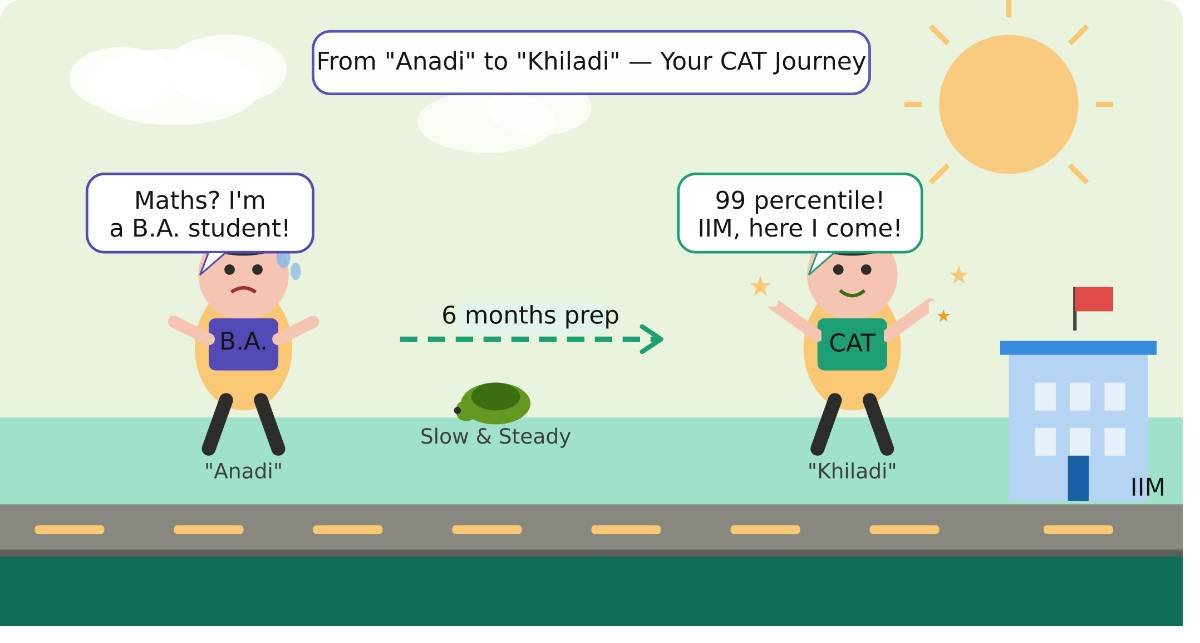
Ready to start your CAT 2026 preparation but unsure where and how to begin? You are probably dealing with a storm of doubts. Many aspirants wonder whether they can crack CAT as a non-engineer, especially when top percentiles often seem dominated by students from technical backgrounds. Others struggle with a deep fear of mathematics — something that is far more common than you think.
But here is the truth: CAT is actually one of the most manageable competitive exams in India when approached with the right strategy. The exam is often misunderstood because students treat it like a school board exam based on memorisation. In reality, CAT tests critical thinking, decision-making, and pressure management. These are not innate talents; they are skills that you can develop over time through smart preparation and consistency — much like the tortoise in the famous fable.
In this article, we will discuss a practical step-by-step strategy to prepare for CAT 2026, improve your aptitude skills, and maximize your chances of securing a seat at your dream B-school.
Phase 1: Building a Strong CAT Foundation (Months 1–2)
if you are a non engineer or a working professional and want to start your CAT 2026 preparation from zero then then this is the most important phase of your preparation journey. Because, it may decide the fate of your final result. Many students rush into solving complex mock tests in the first month and get discouraged by low scores. The focus during this phase must strictly be on understanding fundamental concepts in depth. Most CAT questions look incredibly difficult on a superficial level, but they can be cracked easily if you have a strong foundational knowledge that allows you to see the "trap" the examiner has set.
1.1 Quantitative Aptitude (QA): The Arithmetic Anchor
In this phase, your world should revolve around the basics. You need to focus on the following topics: Percentages, Profit and Loss, Ratios, Averages, Time and Work, Number System, and Algebra.These topics (specifically the Arithmetic ones) form the backbone of the exam. Every year, roughly 35% to 40% of questions in the Quants section come from these areas.
For a complete topic-wise breakdown of all 22 QA questions, the 3 strategies to hit 99 percentile, and a phase-wise preparation plan, read our detailed guide: How to score 99 Percentile in CAT 2027: Quantitative Aptitude Section
Beyond the weightage, these topics are like Lego pieces. A difficult, complex question is usually just a construct made of multiple basic topics. If you understand how a percentage change affects a ratio, you can solve a high-level data interpretation set without needing a calculator.
The "Daily Drill" Checklist
Spend an extra 15–20 minutes daily on these "speed boosters" to save precious seconds during the exam.Component | Daily Target | Why it Matters |
Tables | 1 to 30 | Eliminates manual division time. |
Squares/Cubes | 1 to 30 / 1 to 20 | Essential for Number System & Algebra. |
Fraction-to-% | 1/2 to 1/20 (e.g. 1/7 = 14.28%) | The secret weapon for DI and Arithmetic. |
Puzzles | 2 Basic Sets | Wakes up your logical brain. |
1.2 VARC: Building the Reading Muscle
If you do not have a strong grasp of English grammar (tenses, prepositions, conjunctions, and articles), start there. Proper grammatical knowledge will help you decode complex, winding sentences in Reading Comprehension (RC) passages. Once you have the basics, you must start a rigorous reading habit.I recommend "The Hindu" editorials and "Aeon Essays." These sources cover wide domains like philosophy, sociology, science, and history. Since CAT RCs are often sourced from similar international journals, this prepares your brain to stay focused when reading boring or abstract topics. Additionally, pick up "Good Literature." Read classical authors like George Orwell, Franz Kafka, or Charles Dickens. The purpose is to understand the "tone" and "intent" of the author. This is exactly what the exam asks in summary-based questions and "main idea" questions.
For the complete VARC section breakdown — including the 2 strategies for 99 percentile, RC question-type accuracy targets, and a phase-wise reading plan — see: How to score 99 Percentile in CAT 2026: VARC Section
1.3 DILR: The Brain Exercise
Start with basic Statistics (mean, mode, median) and graph reading. Solve one or two basic puzzles (Linear/Circular arrangements) daily. Do not worry about the timer yet; focus on the logic.For the complete LRDI set-type breakdown, the 90-Second Scan Rule for set selection, and how to identify your personal Set Profile, read: How to score 99 Percentile in CAT 2026: LRDI Section
Phase 2: Moving from Student to CAT Strategist (Months 3–4)
In this "bridge" phase, you move from being a student to being a strategist.2.1 QA: Diversifying the Portfolio
Now you must tackle Inequalities, Logarithms, Progressions, and Geometry. The goal is not necessarily to become a world-class mathematician in every topic. Instead, you should aim to solve at least the simple and medium-level questions from every single topic in the syllabus.The Pareto Priority Matrix
This is where Pareto’s Law comes into play. In the context of CAT, 80% of your marks will come from the 20% of topics you master completely.| Priority | Topics (The "20%") | Exam Impact |
High (Must Master) | Arithmetic (Percentages, Ratios, T&W) | ~40% of QA Section |
Medium (The Edge) | Algebra, Basic Geometry | ~30% of QA Section |
Low (The Bonus) | Permutations, Complex Numbers | ~10% of QA Section |
Want to know exactly how many correct attempts you need in QA to hit 99 percentile — and which strategy fits your profile? Then Click on: How to score 99 Percentile in CAT 2027: Quantitative Aptitude Section
2.2 VARC: The Shift to Application
You need to move from general reading to practicing exam-style questions. This includes Para-jumbles, Odd One Out, and Passage Summaries. You should aim to solve at least two questions of each type every day.Pro Tip: Always try reading the options first in the RCs. This provides a "filter" for your brain. If the options are based on direct facts, you can skim the passage quickly. However, if the options are based on inference or summary, you will know to be more cautious and read for the deeper meaning in one go. This saves a massive amount of time during the actual exam.
The VARC Guide covers 4 specific RC question types (Main Idea, Inference, Author's Tone, Specific Detail) with target accuracy percentages and techniques for each. It also covers the two distinct 99 percentile strategies in full detail: How to score 99 Percentile in CAT 2027: VARC Section
2.3 DILR: The Gold Mine of PYQs
True DILR preparation starts now because it requires more than just basic math. It requires a level of logical comfort that you built in Phase 1. The best way to prepare is to practice actual exam-level sets. Previous Year Questions (PYQs) are a gold mine.Initially, this section will feel mentally exhausting. You might spend an hour on a single set and still not get it right. That is perfectly normal. Start by targeting one set a day, then shift toward two sets, and eventually three. Just like the Quants section, apply Pareto’s Principle here. Identify which themes you are most comfortable with, such as Table-based DI, Games and Tournaments, Venn Diagrams, or Caselets.
Not sure which LRDI set type suits you best? Our detailed guide includes a Set Profile framework (Calculator / Logical Mind / Hybrid) and a topic-wise priority matrix for Phase 2: How to score 99 Percentile in CAT 2027: LRDI Section
If you can master just two out of the four sets in the exam with 100% accuracy, you are already ahead of the majority of candidates.
Phase 3: The Mock Test Intensive & Analysis (Months 5–6)
This is arguably the most enjoyable phase because the heavy lifting of "learning" is done. Now, your routine is simple: wake up, give a mock, analyze the mock, sleep, and repeat. The goal here is to identify your personal strategy, increase your speed, and build the mental stamina required for the 120-minute grind.3.1 Developing Your Strategy: The "10-10-10" Rule
You don't need to solve the whole paper to get a 99th percentile. You need to be smart about what you pick.| Section | Correct Questions | Estimated Percentile |
| VARC | 10 | 97–99%ile |
| DILR | 8-10 (2 Sets) | 98–99%ile |
| QA | 10-12 | 98–99%ile |
| Total | ~30 Questions | 99+ Percentile |
A) The Accuracy Strategy: You make minimum attempts but aim for 100% accuracy. You only touch questions you are absolutely sure about. This works best for students who have identified their "niche" topics and have a very high "hit rate" in those areas.
B) The Attempt Strategy: You maximize your attempts, even if your accuracy is slightly lower (around 70% to 80%). This works best for students who are "jacks of all trades." They might not be masters of any one topic, but they are comfortable enough with everything to take an educated guess or solve the majority of the paper.
You can mix these strategies. For example, if you have poor accuracy in VARC (which is common), you might use the "Attempt Strategy" there to compensate for the potential errors, while using the "Accuracy Strategy" for Quants.
3.2 The Kaizen Rule of Mock Analysis
Kaizen is the Japanese philosophy of continuous improvement. It states that
you only have to perform 1% better than yesterday to eventually reach your
goal. Giving a mock is useless unless you spend at least three hours analyzing
it. You must analyze your performance on these three specific lines:If you... | The Error Type | The Fix |
Didn’t know how to start | Concept Error | Re-visit Phase 1 notes; solve 50 easy Qs. |
Took 5+ minutes but got it right | Strategy Error | Look for a shortcut, option-elimination, or TITA trick. |
Realized it was easy after the mock | Selection Error | Practice “skipping” hard Qs in the first 10 mins. |
3.3 Mental Stamina and the "Afternoon Slump"
Many students struggle in the afternoon CAT slot because they feel sleepy after lunch. Train your body. Sit for a full 120-minute mock specifically during your assigned time slot to peak your alertness.Final Pro Tip: Always attempt TITA (Type In The Answer) questions. They have no negative marking. Even if you are guessing, a TITA box is a "free lottery ticket"—always put an answer in!
How Aptitude360 Mentors You to Success
If CAT is a battlefield, think of Aptitude 360 as your Sarthi—the guide who doesn't just give you the weapons, but teaches you exactly when and how to use them. While this guide provides the roadmap, Aptitude 360 provides the engine. We bridge the gap between "knowing the syllabus" and "mastering the exam" through:- Personalized Mentorship: Helping you identify your unique 10-10-10 strategy.
- The Consistency Anchor: Keeping you on track during the "Phase 2 Blues" when the motivation dips.
- Real-time Course Correction: Detailed analysis that turns your mock test failures into "Kaizen" breakthroughs.
- Beyond
the Percentile: Dedicated handholding for the WAT-PI-GD process, ensuring
you navigate the final interview hurdles to secure your B-school seat.
Conclusion: From Plan to Practice
The roadmap is now in your hands. Remember, the difference between an "Anadi" and a "Khiladi" isn't just intelligence—it is grit. Focus on your 10-10-10 goal, stay consistent, and the B-school of your dreams will be your next destination.See you on the other side of the percentile!